Many churches have children’s corners. It’s hard for little ones to sit still for the whole of a 1-hour service, or to come back in from a Sunday School session where they were allowed to move and play, and suddenly be expected to sit quietly in a pew.
This can mean children get restless and fussy, and parents end up taking them out. Parents feel embarrassed, both parents and children miss out on the service, and worship can get disrupted by a large-scale tantrum. Not good. By providing a children’s corner, where parents can take their children at the first sign of restlessness, this escalation can be largely prevented. (Though kids will sometimes kick off regardless – it helps if it’s a vicar or churchwarden’s kid, so other parents feel more relaxed about their own.)
It’s easy to make the children’s corner just an ordinary secular playspace, but with a slight change in mindset, this can actually be turned into an opportunity for developing children’s spirituality.
Here’s one I made earlier … the “Pray and Play” space at St. George’s Church, Campden Hill, London. Each basket is themed. We have Baptism, Christmas, and Easter, as well as a Noah’s Ark with animals, a book corner, and a small toy altar with liturgical items and a toy church.
The focus is both on the Christian STORY and on Christian WORSHIP.
You can see how the colour of the cloth on the altar shows the liturgical year (except for when we lost our cloths and had all blue for a while while we replaced them!), and how extra items are sometimes added at festivals.
There’s a poster of the Good Shepherd on the wall, and the altar is visible from the Pray and Play area, so children and their adults can still feel connected to the worship.
The treasure boxes contain items similar to the Spiritual Child Network’s liturgy boxes.


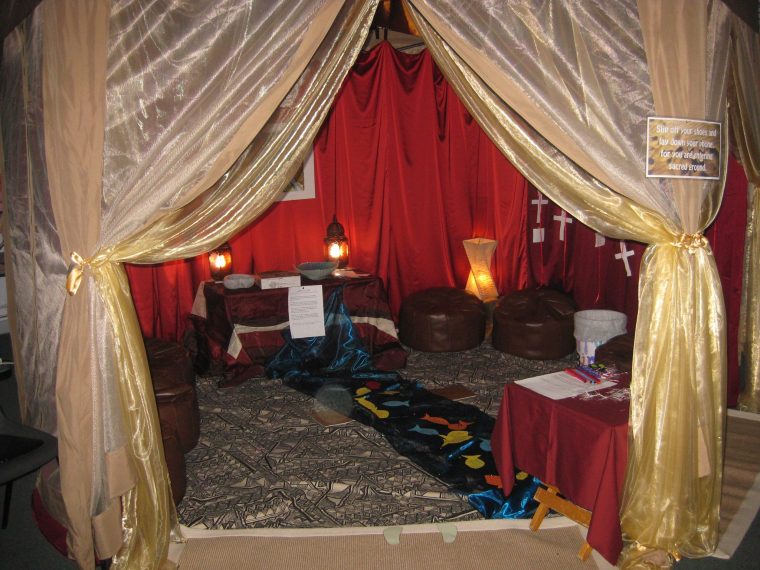
This one was used as a “Meditation Tent” in a Holiday Club in Nottinghamshire, and therefore can be more of a roped-off space than one used during corporate worship. This allows for fantastic creativity in terms of lighting and the overall atmosphere of the space. Note the sign, which reads, “slip off your shoes and lay down your phone, for you are entering sacred ground.” This one would work really well for older children and teens.
You can see more of the Meditation Tent here.
The rug here really reflects a lot of Biblical landscapes (they’re from IKEA). Note the pillow on top of the purple cushions – it has a heart and hands, which is great for cuddling, and which echoes the imagery of God used in the Beulah Land storytelling sets. The table and chairs provide space for creative work – make sure you provide materials allowing for open-ended creation and not just colouring sheets. The coat hanger features Bible-based story sacks, with storybooks and toys connected to that story. Also note the vicar doll! The child is playing with a wooden ark, just visible to the right of her.

 This was a special installation for Pentecost. Its creator says, “in MY head the doll’s house was meant to be the upper room in this case, but with children it could become anyyhing in their heads! It’s also been house-with-stable for Christmas, wedding feast house for water into wine, anyone’s house when we talked about hospitality and sharing things in common…quite versatile!”

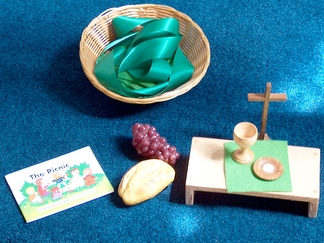
The image below shows how baskets can be used to encourage play based around worship as well as stories. The coloured ribbons can be changed according to the season of the year. For more ideas on children’s area, see the Spiritual Child Network’s page on them. (Wooden egg cups make very good play chalices, by the way!)
I’m getting lots of pictures sent through with many more ideas, so keep checking back for more!
In the meantime, if you’re thinking of setting up a Pray and Play area in your church, and you’d like some help – either in what to include or how to do it without scaring your congregation and starting World War III, do get in touch via cme@stalbans.anglican.org or on our Facebook page!

 Procession:
 Take-home:
 Children's Ministry in St Albans Diocese