Thy Kingdom Come – prayer ideas

kingdom

The Archbishops of Canterbury and York have called on churches throughout England to pray, during the week leading up to Pentecost, for mission, outreach, and evangelism.

Alison Hendy, in the Diocese of Guildford, has put together prayer ideas for families for every day of this week, and has been kind enough to share them with us.

Do print these out, send them home with your families, and encourage them to use them.

Thy Kingdom Come (PDF)

Welcoming the stranger

bread-wine

EDITED: A few changes have been made to the documents, based on readers’ suggestions. Thank you so much – keep the great ideas coming!

Newcomers who aren’t familiar with what happens at church may be nervous and feel unsettled and conspicuous.

I’ve made some simple handouts that you can make available when people come to church.

There’s a version for younger children, with very simple language, and a version for older children and adults, with some more detail. The explanations in the version for older children and adults are designed to be autism-friendly.

There’s also a sheet you can fill in with details about your specific church – where the toilets are, what happens after the service, etc. – to help people feel at home in your building. This is included in the PDF file, but there’s an editable Word version as well, so you can type your explanations in, instead of having to handwrite them!

If there are any improvements you’d like to see, PLEASE do let me know! I want these to be genuinely useful, so I need to know if they’re not.

Please note: when filling in the “Our Church” sheet, avoid jargon!  For example, here are two ways to answer the question “what books or leaflets will I need for the service?”

WRONG: The hymnal will be used for the processional, gradual, offertory, and recessional hymns – the insert will be used for the Psalm. Today’s lectionary readings are found on the insert, while the rest of the congregation’s words for the Eucharist may be found in the seasonal service sheet for Epiphany.

RIGHT: The green book has the words for the songs in it. We call these songs “hymns.” The vicar will tell you what number to turn to for every hymn.  The words we all say together are found in the leaflet with the coloured cover – we use different colours at different times of year.  When there’s a Bible reading, the words for that are on the sheet with the red top that’s stuck inside the leaflet with the coloured cover. One of these readings is a song from the Bible called a Psalm, which we all sing together. If you get confused, feel free look over someone’s shoulder to see what they’re doing, or ask someone sitting near you.

What Happens At Church – both versions, plus Our Church info sheet (PDF)

Our Church (Word)

Why do we tell the story?

I’m working on my talk for our upcoming Storytelling training morning (June 11th at St. Luke’s, Watford – free! Talk to Julie to book your spot, by emailing youthoffice@stalbans.anglican.org.)

Storytelling is central to so much of our work, and we often take it for granted. We talk about doing it well, but how often do we pause to think WHY we’re doing it in the first place?

And of course, our theology of storytelling – our thoughts on why we do it – will inform our practice.

These are some of my thoughts on the function of storytelling as part of worship and Christian nurture. Of course, many people will have elements of many of these – they’re not in direct competition with one another. But which ones are most important to you, and why, will probably affect which stories you tell, and how.

I’d love to hear your thoughts in the comments.storytelling

Stories pass on meaning.  Stories help us figure out the world and our place in it, the struggles of our lives, our relationships with one another, and – in Biblical storytelling – our relationship with God.  With this theology, the story becomes a gift or a road map – something you equip the child with to help them through their journey.  Central to this theology of storytelling is the idea that we each have to make that meaning for ourselves. We have to struggle with the story and figure out how to apply it to our lives. Storytelling based around this theology will strenuously avoid being didactic. It may focus on the struggles of Biblical characters, and of the whole people of Israel, more than their triumphs.  It will seek to address broad themes, such as belonging, loss, and salvation.

Stories create a group identity. When you come into a new organisation, you hear anecdotes about the people and events that have gone before, and by becoming familiar with these stories of the past, you become integrated into the group.  Storytelling that focuses on this theology may be focused on the stories of “the people” as a whole, rather than stories of individuals.  It may emphasise the historical elements of the stories more than the mythical.  It may focus heavily on the stories of the church since the time of Jesus, and on the saints, looking at the community of believers through the ages and our connections to them.  Part of creating this group identity is telling us where we come from – part of what binds the group together is the claiming of our shared history.  “This is who we are, because this is what’s happened to us.”

Stories create an individual identity.  One place in modern society where this function of storytelling is very obvious is in fan culture. By claiming a kinship to the story – be it Star Wars, Doctor Who, or The Hunger Games – a person makes that story a large part of their personal concept of themselves.  Storytelling that focuses on this theology may be very missional, seeking to change individuals’ concepts of themselves. It may focus very heavily on an individual becoming part of a particular subculture (like a “fandom” with fan fiction).  A personal testimony of salvation may be important to this kind of storytelling.

Stories explain our practice, both in our daily lives and in our worship.  This is rooted heavily in our Jewish ancestry. The Passover Seder is a good example of this – the night is designed to make children ask, “wait, what are we doing?” and providing parents with an opportunity to tell the Exodus story by way of an answer. This has become ritually enshrined in the Seder meal itself.  Joshua leaving the stones at the edge of the Jordan is another example of this – he specifically says, “these stones are left here to make children ask why, so that you can tell them this story.”  We see this in Christian worship most clearly at the Eucharist – in order to explain what we’re doing, the priest tells the story of the Last Supper, every time she or he celebrates Communion.  Storytelling based around this theology is similar to that based on the group identity, but links it specifically to a particular culture of worship.

Stories tell us who God is.  Think of how often God begins a discussion with his people by saying, “I am the Lord your God, the God of Abraham, Isaac, and Jacob, who brought you out of Egypt …”  The Judeo-Christian God doesn’t take authority from abstract philosophical principles, but from a relationship – and a relationship is built on stories.  Storytelling based around this theology will focus very heavily on the character and nature of God, and his relationship with his people. It may focus on emotion and symbolism rather than facts.  The nature of the Trinity, and the ways of knowing God, will be central to this type of storytelling.

It’s important to note that storytelling serves almost all these same purposes within FAMILIES. Stories of your parents’ and grandparents’ lives provide a narrative of where you came from and a group identity, and stories that focus on particular family traits (“that Wilson sense of humour again!”) help family members build an individual identity that includes membership of that group as a dominant trait.  Stories of “why we always use real candles on our Christmas tree” or “why we always go to the same place for holiday” explain our practice.  When family members form new romantic relationships, telling the old family stories is a key part of bringing that person into the group and making them feel like they belong.  Storytelling in church is God’s family doing all these things.


Book review: The Art of Curating Worship

curating-worshipMark Pierson’s book is subtitled “reshaping the role of the worship leader.” Based on years of experience in ministry, including founding new churches and supporting artists, he proposes an approach to worship that is democratic, interactive, and based on the principle of “curation” – arranging items and experiences in a meaningful way, to create worship.

Given the way this book has been received, as revolutionary and groundbreaking, I was surprised by how familiar and traditional much of it seemed.  I suspect that’s because I’m Anglican, while Pierson’s audience is much more on the Baptist/Methodist side – much of what he suggests draws on ancient liturgical practices that Anglicans have never really discarded. But he does reframe them in a new and thoughtful way, and suggest useful guidelines for incorporating this particular type of worship planning into your community, whatever their style would be.

There is very little that is explicitly about children (and what is there is disappointing – he once suggests a separate “children’s station” during worship, with “colouring in, etc.”, rather than thinking about how a children’s element could be added to all the stations).  However, it’s easy to see how his principles could be applied to worship that includes children, given how rich, interactive, and multi-sensory his approach is. He also regularly reminds readers that the theology needs to come first – this is something that’s easy to forget in children’s ministry, as we latch on to a great new idea or activity without necessarily thinking first about what it says or why we’re using it (yup, guilty as charged!).

What Evangelicals might like: The focus on reaching out, being missional, engaging with public spaces, and trying bold new forms of worship.

What Traditionalists might like: The affirmation of the importance of ancient forms of liturgy, with inspirational thoughts on how to adapt them to modern times without losing their soul.

Pray and Play

Another wonderful Pray and Play corner, from St. Andrew’s, Bedford. Here’s what Children and Young People’s Activities Coordinator Becky has to say about it:

“There are some of the Lent calendars and some other worksheets/colouring and plain paper for the children to let their imaginations flow. Plus there are some stickers (they always love having stickers so I try to put some out every now and then, I have used some I got from The Word bookshop but the current ones are from Baker Ross with the words of faith).

“The activity bags are Bible story bags, like story bags you get in schools but each is Bible story. They contain a book of the story, some toys that can be used to act out the story and some colouring/worksheets relating to the story as well as a pencil case with colours, etc. I think the current stories in the bags are Jonah and the whale, that has a small plastic doll/figure, a whale toy and I think a boat, there is Moses in the bullrushes, with a small baby doll and basket, Daniel and the lion’s den, with a small doll/figure and small toy lions, David and Goliath, with a large figure (actually one of my sons old wrestling figures but with a tunic on!) and a small figure with a sling shot (that is actually one of the knee pads the wrestling figure used to wear!). I try to update them every now and then with different stories.

“I am also working on making I-spy treasure sensory bag toys with Bible themes (Google search I-spy treasure bags and look on images and you get the idea), these are Autism fidget toys but I think will work well with others too. I currently have collected everything I need to make Holy Week themed ones and one of the lovely ladies at our church is going to sew them for me. I will then work on other Bible stories/Christian symbols/Christmas ones for the rest of the year.”

pray-and-play15

Thy Kingdom Come

Now that Holy Week is over, it’s time to enjoy the 50 days of Easter and look towards Pentecost, celebrating the gift of the Holy Spirit.

The Archbishops of Canterbury and York are inviting Christians around England to join in a week of prayer leading up to the day of Pentecost itself, 15th May.  They’re calling this week “Thy Kingdom Come,” and you can find out more on their website.  The week will culminate with “Beacon Events” around the country, mostly in cathedrals – the nearest one to most of the Diocese will be at St. Paul’s Cathedral in London, though for some parts of Bedfordshire, you may be closer to the Coventry one.

pray-and-play14Why not take that week to explore prayer with some of the children in your church, school, toddler group, lunch club … or even at home?  While the website doesn’t specifically include prayer resources for children in churches (!!!) they do include some ideas for children in schools, which could easily be used in church or other settings. Find them here.

You can also find great prayer ideas at Flame Creative Kids.

If you’d like to create a prayer space with your kids as part of this week, check out the Diocese’s Pinterest board of prayer space ideas.

Thy Kingdom Come suggests praying regularly for five friends – this is a great, concrete way of helping children start learning to pray, and they have some ideas here.

Don’t forget to register your church’s prayer activities on the Thy Kingdom Come website!  And do let me know how you get on, so I can share your experiences with others.


Let the children come to me.

When was the last time you went someplace that intimidated you?

Maybe it was a party where you didn’t know anyone except the host.

Maybe you were taking a toddler to a restaurant or a family wedding.

Maybe you were starting a course, and had to navigate a classroom and classmates for the first time in a while.

Whatever it was, can you remember how it felt to walk in? Can you remember some of the questions that went through your head?

What if nobody talks to me? What if I do something wrong, and obviously wrong, and everyone can see I don’t belong? What if my kid doesn’t behave? What if they need the toilet? Where will I put the pram? Will I know where to sit? Are there unspoken rules that I won’t know?

That’s what’s going through the minds of many young families as they come to church.  Just think of it – the service might be new and unfamiliar, the people are strangers, the atmosphere might be hushed and reverent (and they have a toddler!), and yet their desire to be a part of it, and for their child to know Jesus, is strong enough for them to brave crossing the threshold into your building.

And what happens next?

Do they find a place that puts their fears to rest? Or do they find a place that extinguishes whatever spark brought them there in the first place?

While no church is going to be the right fit for every family that visits once, there are some things you can do to help make new families feel welcome from the start.

  1. Have somebody in your welcome team every week whose job it is specifically to be there for children and families. They should know, by name, the children who come regularly, and greet them. They should know where the nappy changing facilities are, where Sunday School meets and when it starts (if you have Sunday School) and be able to inform parents of any special provision you have for kids – worship bags, a Pray and Play corner, etc.
  2. Have space available in the church for small children to move around. A toddler stuck in a pew will wiggle and make noise and it’s likely that without intervention, this will escalate to a point where the child will need to be taken out. This means the parent will miss part of the service AND feel self-conscious about their child’s behaviour. If you have a children’s corner in the church, parents can move there at the start of the cycle, and nip the escalation in the bud. Ideally, the children’s corner should have a sightline to the altar, and should be filled with spiritually imaginative toys, not secular ones. But if you have no money and all you have are Thomas the Tank Engine toys, start with that – it’s definitely better than nothing!
  3. Many parishioners who seem unwelcoming to children fit into one of two categories. Either there are pastoral reasons why the presence of young children is upsetting (for example, someone who desperately wanted grandchildren and is coming to terms with not having them) or they’re worried that the presence of children and families means the church is going to lose something they value and love, and that is important to them, spiritually (e.g. a strong choral music tradition, a sense of peace and tranquility). When you receive a complaint about the children “making noise,” try to find out what that parishioner is really saying, and minister to that. It may at times be necessary, however, to address the common unconscious belief that many people have – including parents – that children are, primarily, “visitors at an adult event,” who are welcome “as long as they behave.” This thinking causes some parishioners to resent every noticeable sign of the presence of children as taking away from “my” worship experience, and it also has the effect, when parents internalise it, of causing them to focus on getting their child to “behave” rather than helping them actually engage in worship.  This article on Whispering in Church is a brilliant starting point for helping parents engage children in worship rather than just try to get them to be quiet.
  4. Try and make sure that new families who stay after church for coffee talk to someone other than the vicar.  Research from the Christenings Project has shown that meeting even one parishioner other than the vicar significantly increases the chances of a family staying involved with the church. Maybe there are one or two people in your church who are very good at small talk and networking, and they can be unofficially “on duty” to welcome new people, find out a bit about them, and introduce them around.
  5. Does your church speak a different language?  Do you talk, during worship, about the chancel, the narthex, the legilium, the absolution, the sacrament, the Gospel, and the offertory without some indication, for newcomers, of what that all means?  When you say, “talk to Jo for tickets to our quiz evening,” does Jo stand up and wave, or is everyone expected to know who she is?  How user-friendly are your service sheets?  If aliens crash-landed into your service, would they leave knowing something about why you worship as you do and what it all means?  In other words – is the liturgy made for man, not man for the liturgy?
  6. And finally, but perhaps most importantly: what is the mood? Is your church confident in who they are, open to newcomers without feeling threatened by the possible changes they will bring, or are they closed-in and defensive?  If it’s the latter, how can you begin to change that culture?

Holy Week Ideas, Part III: Good Friday

Today, a few questions to guide your thinking:

Who are the children that we might see on Good Friday?

Are these children from the regular congregation, or visitors, or a mixture? How much will they know of the story? What will they know about Jesus apart from his birth at Christmas and his death?

Will they be back for Easter Sunday?

At my last parish, when Good Friday fell the day after school broke up, we had several families come to our Children’s Stations of the Cross.

“See you on Sunday!” I called as they were leaving.

“Oh, no, we’re off on holiday tomorrow – we just came to this before we left,” they replied.

Our service had ended with Jesus dead in the tomb, waiting, suspended, for the last chapter of the story on Sunday morning – and these families were going to miss it.  If your children may not be back for Sunday – incomprehensible as it seems to miss that of all days – maybe it’s worth including, at the end of the service, the reassurance that the story doesn’t end here. Don’t do a full-fledged celebration of Easter, but perhaps allow them to peek behind the curtain and see a preview of what comes next.

And then make sure you celebrate the whole season of Easter, all 50 days, so they can join in the celebration of the resurrection when they come back from wherever they are on Easter morning.

(Note: if you have very emotionally sensitive children, especially young ones, you may also want to include some reassurance of the resurrection at the end – I’ve had children burst into tears when Jesus died, and to leave them in that state for two days feels cruel. The disciples didn’t know how it ended, but we do. Again – don’t celebrate – but promise that this isn’t the end.)

What will happen for them between now and Sunday?

If they are likely to be back on Sunday morning, what will happen for them between now and then? Will Saturday be a day of quiet waiting, or of celebrating? Will any of them be at the Vigil?  How will they mark the transition from death to life – will there be middle-of-the-night mystery, or will they show up on Sunday morning and find the resurrection a fait accompli?  What will those different experiences be like, and does this change how you approach your Good Friday service in any way?

Where are their parents?

Are you providing children’s programmes during an adult service, or are you doing a family service? If the children are away from their parents, what experiences, if any, will they have in common with their parents from today?  Can you and the adult worship leaders work together to provide some links for families to carry on observing the day at home – maybe a take-home activity to do together, or some talking points?

How do they experience the space?

Are they in a church or a programme room? What mood does the space set? Is it relaxed and informal – if so, how do you get the awe and wonder of today’s mystery?  Is it formal and dignified – if so, how do you encourage children to relax enough to fully participate?  Where is the light and darkness in the space? Where is the noise and the silence?

What questions am I likely to get?

It’s impossible to prepare for every question that something as raw and primal as Good Friday might bring up, but you may be called upon to address such questions as “why did God let Jesus die?” “why won’t God raise my nan if he can raise Jesus?” “why are there still cruel things like Syria if Jesus has made it all okay?” and so on.  It might help to spend some time in prayer, considering how to address these issues.

It may also help to think a bit about your own theology of what Good Friday means.

The idea of Jesus dying to satisfy the wrath of a vengeful God has become very ingrained in many churches – so much that many people don’t know there are other theories. But this theology is, for many people, deeply troubling, and doesn’t fit with the characterisation of a faithful God who calls his people time and time again, who keeps his covenants with them.  It might be helpful to consider re-framing the event as Jesus dying not to satisfy God’s bloodlust but to do battle with death itself.  The greatest enemy is death, and this is the Good News – not that God is no longer angry with us, but that death itself no longer holds any power over us.

Holy Week Ideas, Part II: Maundy Thursday

There are many opportunities for child-friendly multi-sensory worship in this service, so I’m just going to do a top ten list! Don’t try to do all of these, but maybe let 1 or 2 spark your imagination:

  1. If you’re in a school, baby and toddler group, or other setting where you have some time, the children can make bread. There are lots of unleavened bread recipes on the internet – even very young children can help add ingredients, stir, and shape the dough. Some unleavened bread recipes bakes in as little as 15 minutes – while it bakes, you can tell the story, do some singing and prayers, and finish by eating the bread you’ve baked.
  2. Start with a bring and share dinner, replicating, to some extent, the Last Supper.  While Passover celebrations in Jesus’s time would have been very different from modern ones (and there’s some debate as to whether the Last Supper was a Passover meal), if you ask people to bring a dish based around lamb, bread, or grape juice, you have a way in to telling the Passover story, connecting it symbolically to the Last Supper, and affirming the central roles played by these foods in both stories.
  3. Why not have the congregation was each other’s feet, instead of having the priest do it all? This gives children a chance to serve as well as be served, reinforces that we all serve one another, and allows them a more hands-on experience with water and with care-giving touch.
  4. If possible, include at least a few children in helping with stripping the altar.
  5. Have prayer stations around the church related to the Maundy Thursday story – plants to touch and smell (the garden of Gethsemane), bread and grape juice (the Eucharist), silver coins, and nails (Judas’s betrayal and the crucifixion).  Write a short reflection or prayer for people to read or use as they go from station to station.
  6. If your Eucharist service will have children present, and they don’t receive communion, what other opportunities will there be for them to engage with the centrality of the Last Supper story to this particular Eucharist? How can you help them feel less left out?  Maybe you can have a bread tasting table as people arrive, with bread from different parts of the world – naan, brioche, matzoh, scones, etc.
  7. If you have a separate children’s event for Maundy Thursday, don’t lose the drama of the adult service, with its transition from light to darkness. This is a really potent way for children to experience Holy Week – light to darkness and back to even greater light. Don’t shy away.
  8. If you have music during the stripping of the altar or processions, make it child-friendly – Taize chants are very good for this, and this one is particularly appropriate for Maundy Thursday or Good Friday.
  9. Display, around the church, a variety of artists’ interpretations of the Last Supper and Jesus’s arrest in Gethsemane. Invite the congregation to walk around and look at them (if your congregation isn’t the “get out and walk around” type, you can provide copies of the images in their service sheets or on screens) and reflect on  the different feelings created by the different images. Provide blank paper and pencils/markers for children to draw their own version of the story during the service.
  10. Send your congregation on a treasure hunt – this works best as a gathering activity or as part of an event that’s not the main Eucharist. Give them a piece of paper labelled in four parts with BREAD, WINE/CUP, WHEAT, GRAPES, and see how many times they can find these images within your church – in pictures, stained glass windows, memorials, carvings, etc.  In many, though not all, churches, there will be lots, which provides a way in for exploring the centrality of the Eucharist. (You can add “LAMB” if you want to include the image of the sacrifice whose blood saves the people – see previous note on the connection with Exodus!)

Holy Week Ideas, Part I: Palm Sunday

palm-sundayProcession:

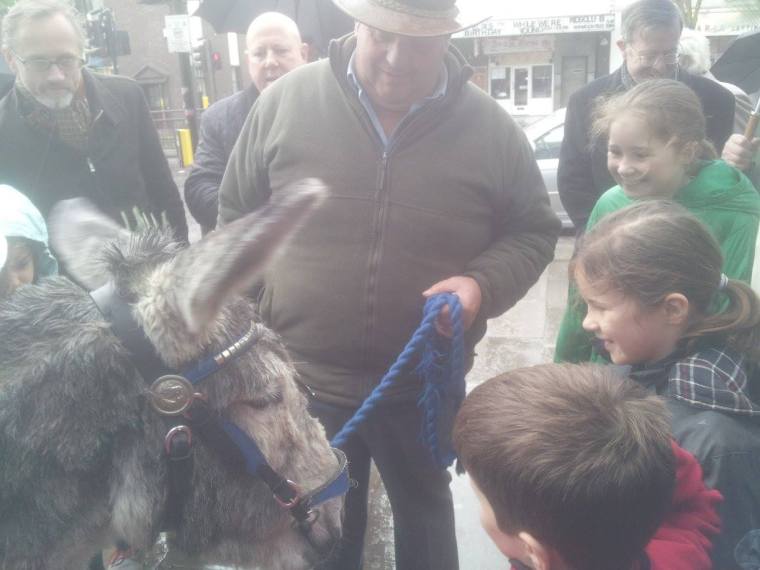
If you have a live donkey, encourage children to invite friends to come to Palm Sunday.  The donkey can be a real selling point, and allow children who might otherwise be shy a way in to asking friends to church.

If you don’t have a live donkey, spend your children’s time this Sunday making a banner, or donkey puppets, or posters (which you can then laminate and put on sticks to make placards) or something else, for children to carry or use in the procession.

Buy real palms, not just palm crosses.  The fun of waving around big branches adds a real element of participation and excitement to this festival.  And they’re not that expensive.  If you have a large church garden, or parishioners with large gardens, you could ask people to bring in a branch or two from whatever shrubs or small trees they have, or provide branches from the church garden.


Storytelling:

The Passion reading is very dramatic, but many churches stick to the traditional way of reading it – a few adults standing in a line at the front.

With an hour’s rehearsal, the adults can dramatise it – act it out, use simple costume pieces – or with a bit more time, you could include children.

Include the congregation as the crowd and the soldiers. The drama of going, in half an hour, from shouting “hosanna!” to shouting “crucify him!” is incredibly powerful, and underlines the culpability of all of us in the death of Jesus. It wasn’t a few specific people in a faraway time who bear the guilt of his death – it’s the sin we all share.


Music:

Many churches will be singing “All Glory, Laud, and Honour” – the chorus is easy to learn, and allows children to participate more fully in the procession. Take some time the week before, or a few minutes at the start of your procession, to teach the chorus so children can sing it with the rest of the congregation.


Holy-Week-Box-all-contents-inside-300x300Take-home:

Send home materials for the Holy Week Box, a wonderful way of extending children’s exploration of the story at home throughout the week.