
This is an idea I got from Ann Sharp, the Early Years Advisor for Chelmsford Diocese. It can be used in Toddler Group worship, in the creche on Sundays – and, with a few “special occasion” additions, at baptisms and weddings with little children present.

Toddlers and little ones may have little patience for sitting still and listening to wordy prayers. Using pictures and movement, we can help them connect to God through prayer in a way that works with natural toddler-ness instead of against it.
Ann also pointed out that toddlers love choosing things, and they love sticking things onto boards with velcro. And the ones are are in Nursery or Reception are probably doing lots of this during the week, so they already know how it works!
I made one myself, in less than an hour and a half from start to finish. I only had to buy the foamboard and velcro, so it cost me less than £10 to get the materials. Many churches will have much of this stuff already in situ.
You will need: a laminator, laminating pouches, a colour printer, A2 foamboard, velcro (I used strips, to cut to size), scissors, Pritt stick.
I decided to use “LET US PRAY” as the centre image, to help teach them the language we use in church every week. You could use “PRAYER BOARD” or “TIME TO TALK TO GOD” or any number of things. I flanked the LET US PRAY image with a group of children and an image of the Holy Spirit.
I used Google for images (See Educational exception to copyright law here).
Then I chose the images for the prayers themselves. I decided on:
- A church (I used a picture of our own church, which the children would recognise)
- A family (I might replace the image I used with one that includes grandparents)
- A group of children playing (I deliberately chose one with children of different ethnicities)
- A child looking sad.
- A child holding a pet.
- The earth.
- A row of houses (I used a street in our parish – check local estate agents’ websites)
- A child in bed with a thermometer in their mouth and a teddy bear.
- A gravestone with flowers on it.
For each image, I came up with one or two sentences to go with it:
- We pray for our church, St. George’s. Help us to know you here and everywhere.
- We pray for our families. Help us to take care of each other.
- We pray for our friends and teachers and schools and nurseries and toddler groups.
- Help everyone who is sad or lonely or scared.
- We pray for our pets and all the animals.
- We pray for everything in the whole wide world and universe.
- We pray for our homes. Make them places where everyone is safe and loved.
- We pray for everyone who is ill or feeling poorly.
- We pray for people and animals who have died. We miss them even though we know they are safe in heaven with you.


I printed out the images and prayers, cut them out, and stuck the prayers on the back of each image. Then I laminated everything and cut it out again.
I stuck the central images to the foamboard with Pritt stick, and cut velcro to size in several rows around it (checking with some of the bigger images that there was space between rows)

This is another reason why strips of velcro might be better than dots – they’re bigger! Very small children might not have the hand-eye coordination to match up small dots of velcro.
When this was done, I stuck the other side of the velcro to the backs of the laminated images, and we were done!
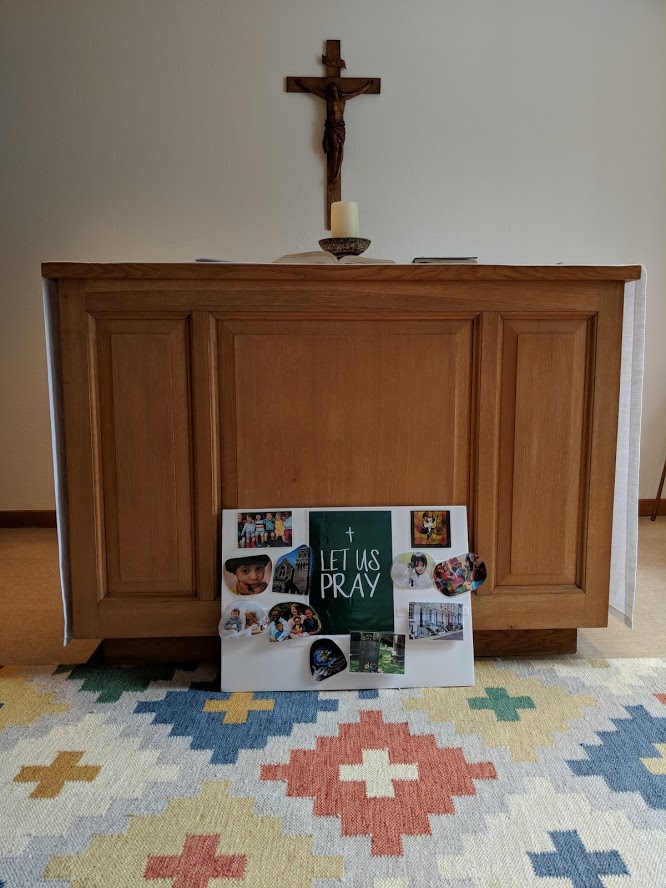
How to use it: I’m planning to put all the images in a drawstring bag, and bring it out with “I wonder what’s in here … !” Under-5s love seeing what’s in the bag/box/etc. They can then choose one to put up, hand it to the leader, who reads the prayer on the back, and hands it back to the child to put on the board. Your group may not have the attention span for all nine prayers every time, so you may only have four or five per session. That’s fine!
If you use the same closing words every time, such as “Lord, in your mercy / Hear our prayer,” you may want to add those to your board.
This could also be something an older group of children/teenagers could make for your younger group.


 to socialise with the other parents, and by the time you get home your kids have been fed and your Friday night is much more relaxed. By starting with the thought “what do our families need?” rather than “how can we make people come to church?” the job of getting people in the door is much easier.
 we chatted about school and families and life, and also talked about what it felt like to get lost and to be found again. Another table made sheep biscuits, another drew pictures of themselves enfolded in the arms of God – and more. By providing a variety of activities, children of different ages, with different skills and interests, were catered for. Messy Church has lots of resources to make this easy for you, so do make sure you get their magazine and
  again and understand them in new ways, and they’re the source of all the symbols and imagery we were exploring during the free choice time. If we gloss over the story, nothing else makes sense! And, importantly, the story was given CONTEXT. Nicola made it clear that this was a story Jesus told. Imagine a kid coming to Messy Church with little Christian background, and hearing “David was little and fought Goliath and won” … okay, who was David? Why should we care? Why isn’t Jesus in this story? A few sentences to explain where the story fits in can help. There were songs that are repeated every session, so people knew them, and a prayer written by the original Messy Church group.
 Children's Ministry in St Albans Diocese