

A reader in our Diocese has shared a wonderful All-Age Mothering Sunday service they did yesterday – please do take a look, and share it if it’s useful to you.
Many of these ideas could also be used at other festivals throughout the year.
A reader in our Diocese has shared a wonderful All-Age Mothering Sunday service they did yesterday – please do take a look, and share it if it’s useful to you.
Many of these ideas could also be used at other festivals throughout the year.
On Saturday, I was asked to lead an hour and fifteen minutes of worship at a retreat/meeting day for the Readers in our Diocese. The ideas I used were supposed to engage the adults present on the day while also inspiring them with things they could take home and use with children in their churches. So they had to be TRULY All-Age!
I led about half an hour of worship at the beginning – the slides for this can be downloaded by clicking here: Readers Retreat Day. For the story, I used Bibliologue, which I’ve written about on this blog before. The song I used is a Hebrew melody, using language from Isaiah as a prayer for reconciliation – appropriate to the story of the Prodigal Son. If you don’t know it, you can hear a tinny recording of me singing it in my office here. The two parts can be sung together, as well – I had the congregation try this. The Lego prayers referred to in the slides can be found here.
Then we had about half an hour to explore prayer stations, which I’ve detailed below. During this time, I played my YouTube Lent playlist, to create a contemplative atmosphere.
In putting together the prayer stations, I was loosely guided by three things:
At the end, I gathered the group back together and talked about how the Prodigal Son is an apt parable for Lent – it shows a time of alienation, ending in reconciliation. Just like the son and father are reconciled at the end, we are reconciled with God at Easter. I read the following from an essay by Debie Thomas on the “Journey With Jesus” blog:
“How exactly did Jesus spend his time? Was he tempted 24/7? Did he walk for miles each day, or camp out in one spot? Where did he sleep? What was the silence like, hour after hour after hour? Did he break it up by humming, laughing, or shouting? Did he star gaze? Play with birds? Chase lizards? As the days stretched on and on, did he fear for his life? Question his sanity? Wish to die? Mark — given, as ever, to brevity — leaves all of these questions unanswered. But the few details he does include in his account are telling, and they give us much to cling to as we face deserts in our own lives. I’d like to focus on three:
Then I said that we are still in that desert time of Lent, but we know Jesus is with us even there, even in the desert. We closed with this wonderful video and some wondering questions.
So now, on to the prayer stations …


I focused several stations on the opening part of the story – the idea of leaving home and going to a distant land. Here, I invited people to think about those who are forced to leave home because of war, and to reflect on what they would bring if they had to leave home quickly. There were then ways to take action on refugee issues.
With children, I might not provide a “donate now” text code.
You can download the leaflet here.

Lots of people wrote prayers for countries where they had connections, or where there is violence. When I’ve done this with children, they often pray for the places their families come from, or places they have been on holiday.

This was a very popular station. The cardboard outlines of people are available from Baker Ross, and are a very flexible resource to have on hand.


This was also a very popular station … I can’t imagine why!
There is not just solemnity in the story, but also rejoicing. So I thought of the image of a party, and went with cake and balloons. Participants were asked to think of something that was going well, and write it with a Sharpie on a balloon. The balloon was left on the altar as an offering of thanksgiving, and then people served themselves cake.
I provided one cake that was Gluten/Dairy free.
 One thing I learned … make sure you have a plan for what to do with all the balloons afterwards! If you’re not able to pop them afterwards (we had lunch, then a Eucharist, so I couldn’t), bring a big bag to carry them out in! I did multiple trips to the car, and my back seat is now full of unpopped balloons …

For people who prefer contemplative silence, we had a side chapel available, with the words of reassurance given to the older brother – “child, you are always with me, and all that is mine is yours” – and some glittery candles. These are electric candles, also available from Baker Ross, and great for staying safe with under-5s. Older groups may wish to use real candles, but still make sure an adult is on hand.

For those who pray best by talking and sharing with others, the Table Talk sets are great! These are available to borrow from Diocesan office – we also have special sets designed for use with Messy Church and for use with teens. Because this was a bought rather than custom-made resource, this prayer station wasn’t specifically about the story. But the fact that it has questions about the nature of God, and friendship/relationship, means it addresses some of the same questions the story does.


This station was about the story as a whole – and again, all these resources are available from Diocesan office. We had fuzzy felt, “The Lost” storybag with its wooden figures of the story, and the wonderful knitted pigs made for us by the Mothers’ Union. I printed out a copy of the story and encouraged people to read it and play with the materials.

And finally, there was a very general open-ended art table, with some ideas to encourage people who might feel stuck when told to “make anything.”
Many of these ideas can be adapted VERY easily for use with other stories – and could be used in Junior Church, Messy Church, All-Age Worship, and more.

A year ago this month, I completed the purchase of my flat.
I got the card above in the post the other day.
On the back was a brief handwritten note from my estate agent congratulating me, saying she hoped I’d been happy in my new home, and to let her know if I needed anything.
And of course I was reminded of Ann, a woman from the church where I served as Children’s Worker for seven years, who lovingly wrote anniversary cards to the family of every child we baptised, until she became too frail to keep it up.
There’s something about the personal touch, about a handwritten card dropping through your letterbox, that makes us feel like someone’s gone the extra mile to care for us – whether that’s simply good customer service, like in an estate agency, or in the broader and more holistic relationship of pastoral care that churches provide.
So if you have an aging congregation, you don’t necessarily need to train them on Mailchimp and social media (though some of them may be more familiar with it than you are – you never know) – don’t forget that a simple handwritten card saying “we remember this important occasion in your life. We shared it with you. We’re here for you” can make a real difference.
A few tips on making the most of it:
One possible wording:
Dear Alan and Sarah,
All of us at St Martin’s send you our love on the anniversary of Jonah’s christening. We hope you have fond memories of this special day. We are praying for you, and Jonah, and Jonah’s godparents, as you all continue to journey together and grow with God.
We promised on that day to be your church family and support you as you raised Jonah to know and love God. We are always pleased to see you at worship on Sunday at 10 am or at our Messy Church on the first Saturday of the month at 3 pm.
May God be with you and Jonah on this special day.
Love,
Revd Jane and everyone at St Martin’s

We’re having a study day on the 3rd of March to look at the topic of WORSHIP in Messy Church.
How can you do worship that engages all ages?
How can you make worship accessible for those new to church?
How to connect worship well with your activities?
And more!
The day is FREE for those paying out of their own pocket – clergy and readers with a training allowance are expected to use it to cover the costs of their place. Lunch is available for a small extra fee.
Most of us will agree it’s really important that our churches reach out to children and families. But what if the thought of holding a baby terrifies you (“what if I just … drop it??”) or if, given a choice between leading a Junior Church session and sitting through every one of these Top 100 Bad Movies without a bathroom break, you’d be reaching for the DVD remote every time?
The good news is, you don’t have to be good with kids to support children’s ministry in your church. All ministry is supported by a lot of background work that makes the face-to-face stuff happen. Here’s a Top Ten list to get us started – feel free to add your own in the comments!
Who remembers playing concentration as a kid?
The rules were so simple – you mixed up the cards and set them out, face-down. You took turns turning over two cards; if they matched, you got to keep them. If not, you had to turn them back over. It’s gently competitive, hard to cheat at, can be played over and over without new equipment, and boosts memory and concentration skills.
It’s also a great way to reinforce the imagery of Bible stories.
A few Bible-based “concentration” games exist, like this one from Orchard Toys, or Alphabet Alley’s “Bible ABC” matching game. (Conflict of interest alert – I own Mustard Seed Kids, the source of that second link.)
But why not make your own? With card, an internet connection, a printer, scissors, and some glue, you can make unique concentration games for any Bible story or festival that has a variety of interesting images.
Here’s the set I made for Christmas:

If you want it to last longer, you should laminate the cards.
As always, when working with images, it’s important to keep a few things in mind. First of all, I’m not an expert on “fair use” of images – obviously, nobody’s making money off this set I made, but if you want to be on the safe side, use Wikimedia Commons for pictures that are free to use, or get a subscription to a clip art or stock photo site.
Secondly, I deliberately used photos for many of these to make the images more vivid – paintings are wonderful (see my previous post for some ideas on using paintings in Junior Church) but photos can help remind us that these were real people! (As can paintings that creatively re-set Bible stories in modern settings … but I’m getting off topic). The image of the shepherd is a modern Palestinian shepherd, and Mary is from the film The Nativity (it’s the same actress from Whale Rider.)
Thirdly, I included a few images they won’t already be familiar with, in the hopes that this game will inspire questioning and learning. The rose is not something we normally associate with Christmas. The blog, “The Jesus Question”, has a wonderful explanation of how rose imagery is used at Christmas by both Catholics and Protestants – with pictures, song lyrics, video clips, and more. The writer there says:
“There does arise one cohesive ‘Christmas Rose’ image: A plant (the Tree of Jesse, …), springing up from Israeli soil. God is the seed, Jesse and others (Abraham, Moses, David, etc.) are the roots, Mary is the stem, and Jesus is the crowning blossom. All the people in the lineage of Christ helped bring him into the world and make up this giant, leafy, flowering plant. And now non-Jews are being graciously grafted in (Romans 11).”
This game could also be included in a children’s corner in church, or as an activity in Messy Church, or as a prayer station in All-Age Worship …
What other festivals could you make concentration games for? What images might you use?
We’ve had a few people ask for a centralised resource bank where we can all share lesson plans, worship ideas, story scripts, and so on, that have worked for us.
I’ve created a Google account using the Children’s Mission Enabler email address – you can all log in with it, contribute your own documents, download other people’s, etc. All the resources are FREE, but by contributing your own, you certify that a) this is your work, and b) you’re okay with other churches and groups using it for free.
To log in, go to Google.co.uk, and make sure you’re signed out of any other Google accounts you have. Then log in using:
Email address: cme@stalbans.anglican.org
Password: matthew185 (for Matthew 18:5 “whoever welcomes one such child in my name welcomes me.”)
So far, I only have three folders – I expect there will be more later on:

To add your own, double-click on the folder you want to save it in, then either drag and drop files, or use the blue “NEW” button at the top:
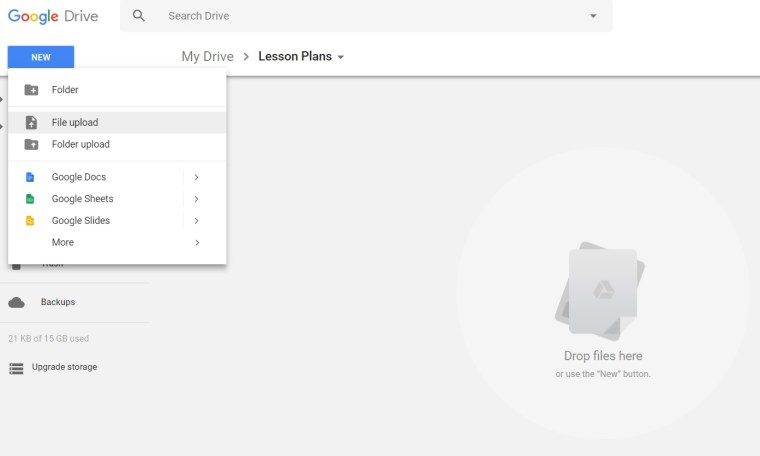
To download a resource, double-click on it. This will open it up in the browser. Then click on the download arrow in the top right. You can also print it directly from the browser using the printer icon next to the download arrow.

I hope this is useful! Do let me know how you get on – you can reach me on the email listed above.
We had our Harvest Festival at my church last Sunday, and we added a few prayer stations. Some were inspired by Mina Munns’s work on Flame Creative Kids .
This is a congregation that doesn’t get up and move around. So we’ve learned that if we want people to engage with prayer stations, we need to find places where they’re already naturally walking past them in worship. We had:


2. An Under-5s sensory prayer table in our Pray and Play area. There are touch-and-feel books about Creation, a tub full of plastic toy animals, and some bread and fruit to try. (There was a bin discretely present, as well, as toddlers don’t eat neatly.) We used a low table, so they could reach.

3. An All-Age (in practice, it was mostly 5-to-15s who used it) prayer space near the candle stand. People walk past the candle stand on the way back from communion, and often pause to light a candle. We’ve found people will sometimes engage with another prayer station in this space, at that time. It’s also near where the children sit together for the Liturgy of the Word in our All-Age services, so they used it a lot during that time, when “sitting still for talking” became too much and they needed something to do with their hands to help them engage.
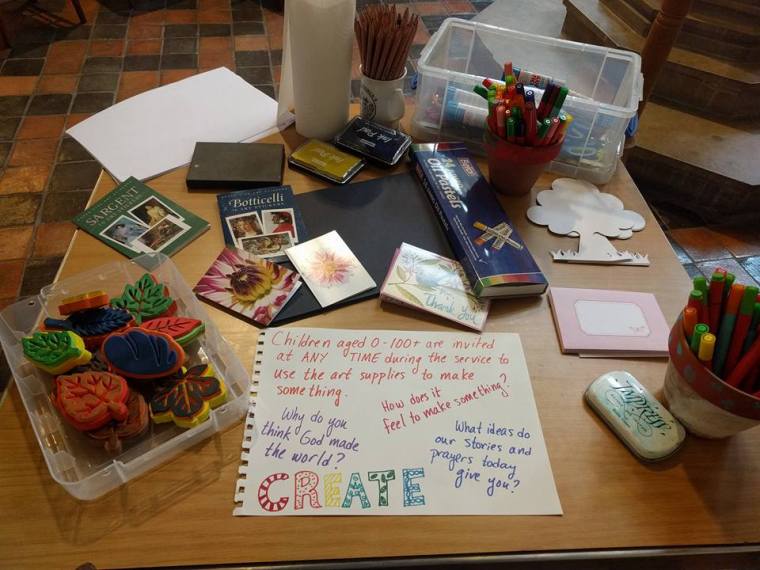
The tree outlines and the leaf stamps are from Baker Ross.
Recently I had the privilege of doing a workshop on Starting Children’s Ministry at the Diocese’s “Leading Your Church Into Growth” conference, and also a lecture on “From Childhood to Maturity” in BELIEF Bedford’s “stages of life/faith” series.

The slides for both these talks are below.
The LYCiG slide makes reference to a few “rules” when it talks about communication with families. Since I don’t explain those on the slides themselves, here’s a short summary:
The First Date rule: you can find more about that here. Basically, the idea is that after a first contact, like a first date, SOMEONE has to make the call to see if you want to see each other again. With the church/family relationship, that might as well be you! The family might be nervous about approaching the church, or just might keep forgetting to get around to it. Send them an invitation to something – make it as easy as possible for them to come back.
The Debenhams rule: I stole this one from Sandra Millar’s Baptism Matters talk – when you go to a shop and buy something, if you give them their email address, they will keep you on their mailing list until YOU ask to be taken off. They will never say, “oh well, Jane Smith hasn’t been back to Debenhams for two years, guess she’s not interested, let’s take her off our list.” The church, however, often does just this – and when many families say they come to church for Christenings but then won’t come back regularly until their children hit school age, this is really self-defeating.
The nightclub lesson: Another one from Sandra Millar. We who are used to going to church, and feel comfortable there, need to remember how scary it is for people who aren’t familiar with the culture and what happens there. You might feel unsure of yourself going into a betting shop or a hot new nightclub (or maybe not – I don’t judge), so remember those feelings of uncertainty and think how you can help people feel comfortable and like they know what to do when they come to church.
The catch and release rule: This is about the importance of getting contacts at every event where you have families. Your crib service, your Harvest festival, your Messy Church – get the details of families and then add them to mailing lists, inviting them back for whatever events are family-friendly. Invite your Messy Church families to your crib service, invite your Christening families to Messy Church – if someone finds you from one part of your church, grab their contact details and then invite them to everything.
Here are the slides:
LYCiG (Leading Your Church Into Growth)

The wonderful Revd Ally Barrett has put together some All-Age Harvest ideas! Have a look.
 Children's Ministry in St Albans Diocese