Prayer bracelets update

I’ve now done the prayer bracelet activity with the children in my Sunday School group – I used a set of coloured beads from Hobbycraft, and bought some of their cross-shaped beads as well.

We did Psalm 23 for the story part of the session, using this book. The illustrations provided rich material for discussing the psalm, and the children are doing the Old Testament stories of the time of the Kings, so they had some context for when and why the psalm was written.

I then let them loose to make the bracelets, having suggested:

  1. They can assign meaning to the colours themselves (maybe “thank you,” “help,” “wow”) and then hold a particular bead when they feel the need for that prayer.
  2. They could choose a colour for each line of Psalm 23, and then say the psalm as they work their way around the bracelet.
  3. They could rotate between two or three different prayers, like doing a rosary.

I then gave them and their parents the handout (below), to help them learn some of the suggested prayers at home.

Children who wanted to make more than one bracelet were encouraged to make one for a family member or friend.

As our Year 6s were coming up to exams when we did this activity, I suggested wearing the prayer bracelet to their exams and using it if needed to relax them and remind them God was with them.

Prayer bracelets

Starburst conference handouts and slides

This Saturday, I had the privilege of attending the Starburst conference in the Diocese of Peterborough, and leading workshops on All-Age Worship and Storytelling.

Below are the slides from the workshops, and all the handouts, in case you missed out. (The Worship Clock and the Elements of Worship sheet are missing – I don’t have access to them today, so I’ll post them tomorrow.)

For more on the Beulah Land “fuzzy felt” Bible storytelling, you can visit Mustard Seed Kids (be aware this is my company, so there’s a conflict of interest).

For more on Godly Play, visit Gody Play UK’s website.

Starburst All-Age Worship (presentation slides)

Starburst Storytelling (presentation slides)

Basic Resource List Starburst

Going to Church No Diocesan Branding

Going to Church Older No Diocesan Branding

Helping Kids With Behaviour In Church

Whispering in Church

The Big Story – concepts

Pray and Play Corners_full versionPray and Play Corners_full version2Pray and Play Corners_full version3Pray and Play Corners_full version4

Tools, not toys

childrenThis is a wonderful article on how to use the new craze for “spinners” productively, to help children focus, accept differences, and “fidget productively.”

It’s very applicable to churches – worship, including in Junior Church, often requires periods of sitting still, listening, and so on, which some children find difficult. Providing ways for children to fidget productively – with pew bags or liturgy boxes or physical prayer objects or just good old-fashioned paper and pens – can help children engage more deeply in worship and feel more at home in church.

(Link will open in a new tab.)


Simple Prayer Idea

beads

My Sunday School kids often come in with friendship bracelets or beaded jewellery they’ve made, so I’m thinking I can turn that interest into a prayer activity.

I’m planning to separate the beads by colour and assign each colour to a simple one-line prayer. For example:

RED: Please protect everyone I love.

ORANGE: I have so many questions – help me hear your answers.

YELLOW: Shine your light into the dark places.

GREEN: Protect this beautiful earth you’ve made.

BLUE: Be with me when I’m feeling sad and blue.

PURPLE: Forgive me when I realise I’m sorry.

WHITE: Thank you for all the good things.

BLACK: Help everyone in the world who needs you.

You can either print out the sentences, laminate them, and tie them onto the bracelets when they’re done (print on both sides so the card isn’t huge), or you can provide them as separate cards.

Allow children to make their own patterns with the different colours, then allow them to spend some time using the bracelets to pray. There are two ways to use the bracelets (maybe you or your kids can think of more) – and they’re both appropriate at different times:

  1. Hold each bead in turn and say the sentence that goes with it. Pray your way around the whole bracelet.
  2. When you need a particular prayer, use the beads of just that colour to help you connect with that prayer.

Children’s Spirituality

11338852633_ef41fae0e0_oI’ve had the opportunity a few times recently to talk about children’s spiritual development in a more academic way.
The slides for this talk are attached – both a longer and shorter version.

The longer version includes a clip from the TV show “Outnumbered,” if you’re into that sort of thing – to find out what that has to do with children in church, you’ll just have to read the presentation!


childrens-spirituality-theory

childrens-spirituality-shorter-version

Imaginative Spiritual Play in action

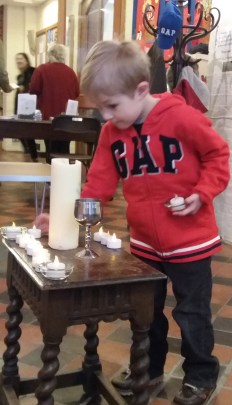
20170205_093750Those of you who have been to any of my workshops or training sessions might have heard me talk about “imaginative spiritual play” and how to facilitate it. Yesterday, Patrick, aged 5, gave me a good example.
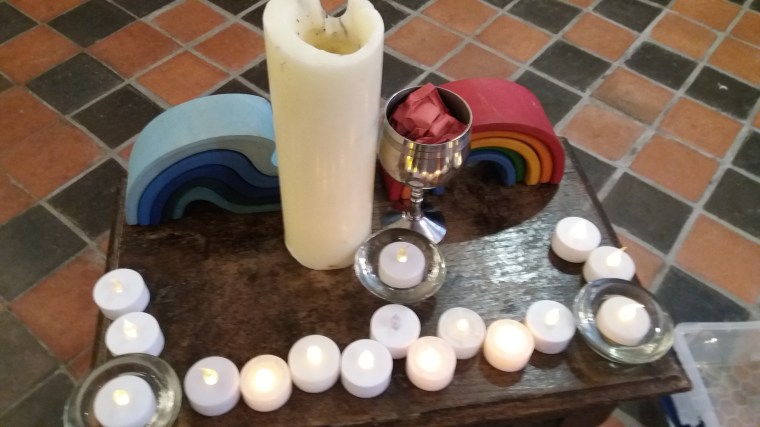
His mum was leading one of the Sunday School groups, so he arrived early. As the space was set up, he started playing – first, he arranged the electric candles on the altar.

What I did: got more candles when he asked, helped him come up with an idea on how to arrange them when he was frustrated that there weren’t enough to go all the way around.

Then he asked me if I had any red paper. He balled up the red paper and stuck it in the chalice to be wine.

20170205_094351

He also went to the toy corner and got the wave and the rainbow toys and set them on the altar.

What I did: Asked him about his setup, using open-ended questions, e.g., “would you like to tell me about what you’ve made?” rather than “is that rainbow from the Noah story?”

When I asked him about his setup, he explained that the water and the rainbow were, in fact, from the Noah story, and asked me if I’d heard this story.

What I did: Instead of saying, “yes, I know that story,” I asked him to tell it to me.

20170205_094928Using the rainbow and the water wave, he briefly recapped the Noah story, and then asked if we could take out the plastic animals from the cupboard to play with them. As the service was about to start, so we had to go into the main worship area, I said no, but reminded him there was a Noah’s Ark toy in the church’s Pray and Play area if he wanted to go and play with that during the start of the service, before Sunday School began.

What made this work:

  1. Easy availability of toys that aren’t proscriptive in their usage – flexibility of symbolism in, for example, the water toy, lets it be used for play based around lots of different stories, or around baptism, or just exploring its shapes and colours and textures and becoming familiar with the image that way. The toy corner in our Sunday School areas, as well as our Pray and Play area, doesn’t change that much – it’s not tied to the story of the day. The same toys are available year round, with a few extra at festivals.
  2. A pretty laissez-faire approach from the facilitator. This episode was child-led. I was the audience – he wanted me to see what he was doing – but not the leader. I helped when asked, but I didn’t direct his play or tell him what meaning to make from it.
  3. Patrick’s familiarity with Bible stories. Patrick’s mum is a Sunday School volunteer and leads our toddler group. She reads Bible stories at home and Patrick is in church most Sundays. But that doesn’t mean she’s doing anything complicated – she’s just making sure he knows the stories, the same way he becomes familiar with, say, Thomas the Tank Engine stories. That’s the foundation of this kind of play, and it isn’t hard to do.


Holy Week Ideas, Part III: Good Friday

Today, a few questions to guide your thinking:

Who are the children that we might see on Good Friday?

Are these children from the regular congregation, or visitors, or a mixture? How much will they know of the story? What will they know about Jesus apart from his birth at Christmas and his death?

Will they be back for Easter Sunday?

At my last parish, when Good Friday fell the day after school broke up, we had several families come to our Children’s Stations of the Cross.

“See you on Sunday!” I called as they were leaving.

“Oh, no, we’re off on holiday tomorrow – we just came to this before we left,” they replied.

Our service had ended with Jesus dead in the tomb, waiting, suspended, for the last chapter of the story on Sunday morning – and these families were going to miss it.  If your children may not be back for Sunday – incomprehensible as it seems to miss that of all days – maybe it’s worth including, at the end of the service, the reassurance that the story doesn’t end here. Don’t do a full-fledged celebration of Easter, but perhaps allow them to peek behind the curtain and see a preview of what comes next.

And then make sure you celebrate the whole season of Easter, all 50 days, so they can join in the celebration of the resurrection when they come back from wherever they are on Easter morning.

(Note: if you have very emotionally sensitive children, especially young ones, you may also want to include some reassurance of the resurrection at the end – I’ve had children burst into tears when Jesus died, and to leave them in that state for two days feels cruel. The disciples didn’t know how it ended, but we do. Again – don’t celebrate – but promise that this isn’t the end.)

What will happen for them between now and Sunday?

If they are likely to be back on Sunday morning, what will happen for them between now and then? Will Saturday be a day of quiet waiting, or of celebrating? Will any of them be at the Vigil?  How will they mark the transition from death to life – will there be middle-of-the-night mystery, or will they show up on Sunday morning and find the resurrection a fait accompli?  What will those different experiences be like, and does this change how you approach your Good Friday service in any way?

Where are their parents?

Are you providing children’s programmes during an adult service, or are you doing a family service? If the children are away from their parents, what experiences, if any, will they have in common with their parents from today?  Can you and the adult worship leaders work together to provide some links for families to carry on observing the day at home – maybe a take-home activity to do together, or some talking points?

How do they experience the space?

Are they in a church or a programme room? What mood does the space set? Is it relaxed and informal – if so, how do you get the awe and wonder of today’s mystery?  Is it formal and dignified – if so, how do you encourage children to relax enough to fully participate?  Where is the light and darkness in the space? Where is the noise and the silence?

What questions am I likely to get?

It’s impossible to prepare for every question that something as raw and primal as Good Friday might bring up, but you may be called upon to address such questions as “why did God let Jesus die?” “why won’t God raise my nan if he can raise Jesus?” “why are there still cruel things like Syria if Jesus has made it all okay?” and so on.  It might help to spend some time in prayer, considering how to address these issues.

It may also help to think a bit about your own theology of what Good Friday means.

The idea of Jesus dying to satisfy the wrath of a vengeful God has become very ingrained in many churches – so much that many people don’t know there are other theories. But this theology is, for many people, deeply troubling, and doesn’t fit with the characterisation of a faithful God who calls his people time and time again, who keeps his covenants with them.  It might be helpful to consider re-framing the event as Jesus dying not to satisfy God’s bloodlust but to do battle with death itself.  The greatest enemy is death, and this is the Good News – not that God is no longer angry with us, but that death itself no longer holds any power over us.