Tools, not toys

childrenThis is a wonderful article on how to use the new craze for “spinners” productively, to help children focus, accept differences, and “fidget productively.”

It’s very applicable to churches – worship, including in Junior Church, often requires periods of sitting still, listening, and so on, which some children find difficult. Providing ways for children to fidget productively – with pew bags or liturgy boxes or physical prayer objects or just good old-fashioned paper and pens – can help children engage more deeply in worship and feel more at home in church.

(Link will open in a new tab.)


Imaginative Spiritual Play in action

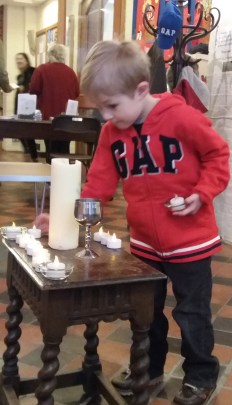
20170205_093750Those of you who have been to any of my workshops or training sessions might have heard me talk about “imaginative spiritual play” and how to facilitate it. Yesterday, Patrick, aged 5, gave me a good example.

His mum was leading one of the Sunday School groups, so he arrived early. As the space was set up, he started playing – first, he arranged the electric candles on the altar.

What I did: got more candles when he asked, helped him come up with an idea on how to arrange them when he was frustrated that there weren’t enough to go all the way around.

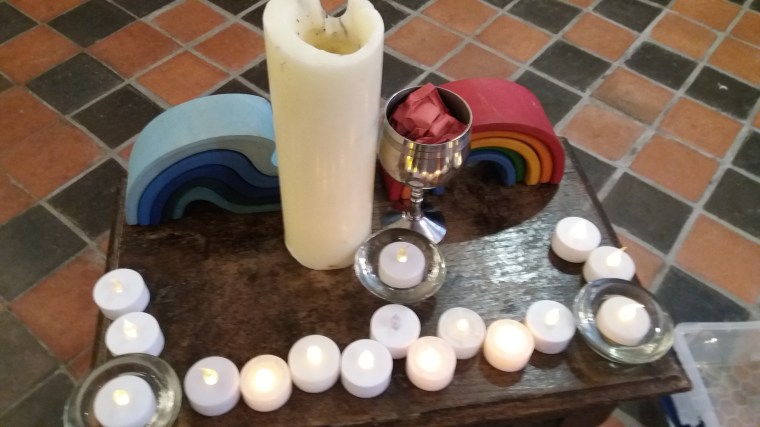
Then he asked me if I had any red paper. He balled up the red paper and stuck it in the chalice to be wine.

20170205_094351

He also went to the toy corner and got the wave and the rainbow toys and set them on the altar.

What I did: Asked him about his setup, using open-ended questions, e.g., “would you like to tell me about what you’ve made?” rather than “is that rainbow from the Noah story?”

When I asked him about his setup, he explained that the water and the rainbow were, in fact, from the Noah story, and asked me if I’d heard this story.

What I did: Instead of saying, “yes, I know that story,” I asked him to tell it to me.

20170205_094928Using the rainbow and the water wave, he briefly recapped the Noah story, and then asked if we could take out the plastic animals from the cupboard to play with them. As the service was about to start, so we had to go into the main worship area, I said no, but reminded him there was a Noah’s Ark toy in the church’s Pray and Play area if he wanted to go and play with that during the start of the service, before Sunday School began.

What made this work:

  1. Easy availability of toys that aren’t proscriptive in their usage – flexibility of symbolism in, for example, the water toy, lets it be used for play based around lots of different stories, or around baptism, or just exploring its shapes and colours and textures and becoming familiar with the image that way. The toy corner in our Sunday School areas, as well as our Pray and Play area, doesn’t change that much – it’s not tied to the story of the day. The same toys are available year round, with a few extra at festivals.
  2. A pretty laissez-faire approach from the facilitator. This episode was child-led. I was the audience – he wanted me to see what he was doing – but not the leader. I helped when asked, but I didn’t direct his play or tell him what meaning to make from it.
  3. Patrick’s familiarity with Bible stories. Patrick’s mum is a Sunday School volunteer and leads our toddler group. She reads Bible stories at home and Patrick is in church most Sundays. But that doesn’t mean she’s doing anything complicated – she’s just making sure he knows the stories, the same way he becomes familiar with, say, Thomas the Tank Engine stories. That’s the foundation of this kind of play, and it isn’t hard to do.


Free Holy Week stuff!

12Tomorrow is our day on Creative Holy Week for All Ages – so for those of you who can’t be there, here are all the resources.

You’ll find:

  1. A script for a walk-through of the whole Passion story. This is great for Messy Church or clubs or other settings where the children probably won’t be in church for Holy Week itself and may not get anything between Palm Sunday and Easter (or not even that). This is in the file labelled “Risen With Christ Resource Pack” and is based on the Prayer Walk in Gretchen Wolff Pritchard’s book Risen With Christ, which you can get here. (It’s worth dealing with the antiquated website and having to order by email or post – it’s a very useful book.)
  2. A summary of how we used the imagery of trees throughout our worship in Lent, Holy Week, and Easter (also in the first file below).
  3. A plan for an all-age Maundy Thursday service. This works for groups up to about 20 – for larger groups, you’ll need to rework it. We have our all-age service at 5:30 and our main Eucharist at 8 – the all-age service tends to attract families and older people who don’t want to be out late, while the Eucharist gets those in between.
  4. The Beulah Land Exodus story script, which is used in the Maundy Thursday service.
  5. The service sheet for my Children’s Stations of the Cross, which provides pretty much everything you need to re-create the service.
  6. Materials which make the transition period of the Great Vigil of Easter much more interactive and dramatic. Many of these are also based on what’s found in Risen With Christ, which in turn was largely inspired by Rick Fabian and Don Schell, who planted the church of St. Gregory of Nyssa in San Francisco (in this setup, the service starts with the kindling of the New Fire and then moves on to the Old Testament readings, instead of vice versa):
    1. The Noble Joseph” – Orthodox Bulgarian chant, used at the end of the Old Testament lessons.
    2. The Litany of the Saints – used for procession to the font before the Exsultet.
    3. The Easter Sermon of St. John Chrysostom – used after the Exsultet, culminating in the first proclamation of the resurrection

Don’t forget to also check out my Lent and Easter Pinterest board – and send me anything you find that you think I should add to it!


risen-with-christ-resource-pack

maundy-thursday-family-service-plan

7_exodus

stations-of-the-cross-service-leaflet

noble-joseph

the-litany-of-the-saints

easter-sermon-of-st-john-chrysostom

First Dates by the Manger

I set up two of my friends recently – they had a lot in common, they seemed to be looking for what the other one had to offer, and I thought they’d get on.

They agreed to meet up and they went out! There were candles, there was poetry … all the ingredients of a special occasion.

A few weeks later, I asked one of them if there had been a second date.

“No,” she said. “I really liked him!  He gave all the right signals, but then he never called … guess he didn’t want me after all.”

So I went to my other friend and asked why he’d never arranged a second date.

“Well,” he said. “I organised the first one. I reckoned if she was keen, she’d call me, and set up a second date. It’s a shame – I really liked her.”

This story is made up. While I am, in fact, responsible for introducing TWO of the couples in my immediate circle ninebreaker-at-deviantart-madonna-and-childof friends, this particular matchmaking venture didn’t take place. This is, in fact, a fictional version of the elusive courtship relationship your church has with young families.

Your church wants young families. Young families want a friendly and meaningful religious community where they feel welcomed, loved, cared for, and wanted. You meet up for a Crib Service – there are candles and poetry, and it’s a really special event. You smile at each other and say how lovely it was to meet up, and you’d love to do it again.

And then you both sit at home, waiting for the other to make the first move.

Research from the Christenings Project shows that families WANT the church to stay in touch. They want to be invited back to special events and to family-friendly services. But families are busier than ever, they’re nervous about their child’s behaviour in church, and they don’t know what’s happening at your church if you don’t tell them. So you need to make the effort. You need to reach out. You need to woo.

This Christmas Eve, why not hand families who come to your Crib Service a small sheet of paper with a space for them to write down their name, their child(ren)’s name(s), their email address, and whether they’d like to be contacted about future events?  You know they like you – they’ve come to your Crib Service!

Have someone at the back of the church at the end of the service to gather these papers in and hand out something special to take home (a chocolate coin, a cut-out-and-keep Nativity, or something else).  Then add these email addresses to your mailing list and invite them back for Candlemas … Mothering Sunday … Holy Week … toddler group … holiday club … and don’t take them off the list unless they ask you to! Conventional wisdom in the marketing world is that people need to be reminded of something seven times before they’ll take action on it. Keep inviting them back.

After all, that’s what God does, isn’t it? He goes out into the highways and the byways and says “we’re having a feast! Come on in!”  And he keeps asking, and keeps asking, because he loves us so much and he wants us to be together, near him – he calls his people to be his Bride.  Let’s model that persistent courtship in our churches.

(And if anyone wants my services as a real-life matchmaker, do get in touch. I can provide two happy couples as references! One couple was even introduced to each other, by me, in a church. So you never know …)

Ministry With Under-5s Day: further resources

Last Saturday, we had a wonderful day on Ministry With Under-5s.  As part of it, I did a whistle-stop tour through the idea of Pray and Play corners – my slides are below, if anyone would like to share the presentation or be reminded of what was covered.

Some other takeaways from the day include:

Ellie Wilson did our keynote address. While she has unfortunately left her post in the Diocese of Leeds, her legacy includes support of “1277: Make Them Count” and also the Toddler Group Research Project, which will be published soon – check back here for more!

Vicki Howie, who did a wonderful workshop on Storytelling with under-5s, recently did a Childrenswork article on a similar topic, which you can find here.

30844981952_3df1f5dc22_kJenny Paddison introduced us to Starting Rite, which is a 5-week programme of spiritual nurture for carers and babies together, based on the type of course run by Sure Start centres. You can learn more here.

Carolynn Pritchard led a workshop on liturgical worship with children – many of her ideas can be found on the Spiritual Child Network page. (There’s also a Facebook group of 700+ members, which I’ve found invaluable on many occasions, for ideas and inspiration.)

Victoria Beech and Becky May did a workshop on music and multi-sensory worship – they both do wonderful Faith at Home work as well. Victoria runs GodVenture, and Becky and her husband Adam are the Treasure Box People.

Any other resources you have for Under-5s are more than welcome – please do leave a comment.

PDF of Pray and Play Corners presentation: pray-and-play-corners

Five-Finger Prayer

There are dozens of versions of this prayer out there – it’s an easy way to involve children physically in prayer, and works with anyone from toddlers to pre-teens (and sometimes even teens).

This is the one I use. I like how each prayer connects in some way to that particular finger – it’s not just random. The Revd. Ally Barrett has added a final piece to this prayer – she draws a circle on her palm as she prays for the whole world. I think that’s a great addition.

five-finger-prayer

All-Age Worship Ideas, Part 2

Today, my dears, we look at STORYTELLING.

In the standard Anglican Eucharist, there’s a looooong section of pretty talky stuff, from the end of the first hymn through to the end of the prayers.  That’s about 30-45 minutes of very verbal worship, including:

  1. Opening collect, confession, and absolution
  2. Three Bible readings of wildly varying length
  3. A sermon
  4. Intercessions, also of wildly varying length

Yes, there’s some music mixed up in there, but overwhelmingly, the expectation is “sit still and listen, and learn orally.”

Anything that can be done to break up this chunk of text is a good thing – not just for children, who, in general, have short attention spans and less social conditioning to hide their boredom, but for adults whose learning styles may vary just as much as children’s do.

Which is not to say that you need to jazz up your service with bouncy castles, a juggling act, interpretive dance, stand-up comedy routines, and a mariachi band, but rather, think about ways in which, while maintaining your church’s tradition, you can perhaps open up the liturgy a bit to some creative new ideas.

The easiest way to do this is by trimming down the Liturgy of the Word – possibly cutting one of the non-Gospel readings – and thinking about how to bring the main story of the day to life in a meaningful way.  Note: THIS IS NOT NECESSARILY THE GOSPEL!

Here are some of the things I’ve done – and some of the mistakes I’ve made. Learn from my failures!

Acting it out.

This is the same Pentecost service I featured in Monday’s post. The children had made flames on sticks in the same Sunday School session as making their doves, a week or two before Pentecost, and had also practiced acting out the story.  We had one final practice half an hour before the service started.  The right-hand picture shows them going out into the “streets of Jerusalem” and telling the congregation the good news – I gave them a line to use: “Jesus Christ is risen from the dead and he is Lord!” if they wanted to actually talk to people but didn’t know what to say.

I was the reader for this lesson, which meant I could pause and nudge them if they forgot what to do – and the general atmosphere was welcoming and informal. They weren’t being judged on a standard of performance; that’s not what this is about. This is about enhancing their understanding of the story through inhabiting it, and helping the adults in the congregation see it through fresh eyes. We’ve all done it – heard the first line of the lesson, gone, “oh, I know this story,” and spent the rest of the reading paging through the notices to find out when the garden party is. If there’s something to look at, something happening, adults are forced to actually pay attention to the story !

If you like, you can also act out the story with adults and children together. The Candlemas story is good for this – choose a matriarch and patriarch of the church to be Simeon and Anna, and teenagers to be Mary and Joseph. If you’re able to have a real baby, even better!

You can also do ad hoc performances, with very little rehearsal. The Moses story on Mothering Sunday is particularly good for this one – with a blue length of fabric and some active seven-year-olds to shake it, you have a river, and then you just need a baby doll in a basket, someone to be Moses’s mother and Miriam, someone to be Pharaoh’s daughter, and, if you have extras, you can have a group of Egyptians and tell them to order around a group of Israelites at the start to establish the social order.

Again, this is usually all done by miming – I don’t give the children lines to read (except for the Passion Play on Palm Sunday). I read the text of the lesson – when I’m directing an ad hoc performance, I’ll take a break, and, with a slightly less formal but still reverent tone, turn from the microphone and give instructions (e.g., “all right, now the Egyptians, you can pretend to hit and order around the Israelites – be careful to only pretend.”).  By keeping my tone elevated, I don’t detract from the importance of the story, or break the mood.

LEARN FROM MY FAILURE: If the story you’re acting out is the Gospel, you’ll need to have the congregation sit for it, against all their instincts, or else they won’t be able to see.

Using Beulah Land
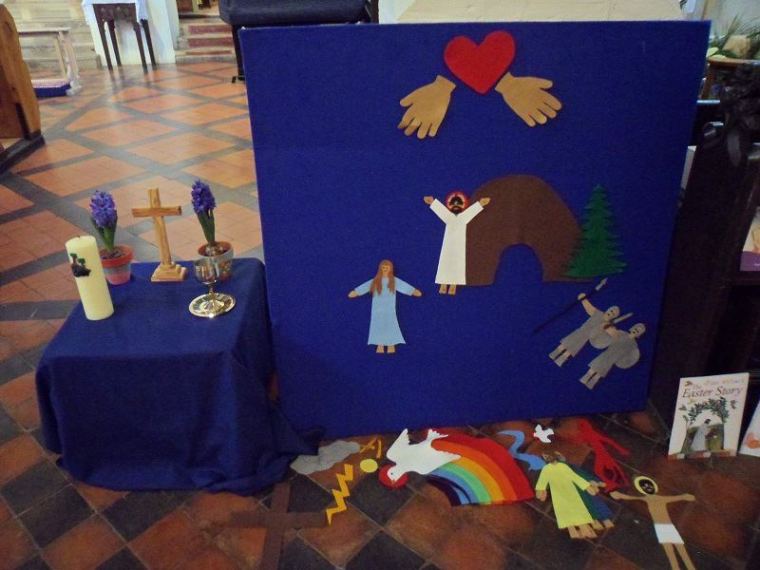
11338301463_6fbcfbd4a3_o

Unlike Godly Play, Beulah Land is large-scale enough to easily be used in All-Age Worship. You can use the scripts that come with it, or you can use the original Biblical text.

harvest

I told the story by moving the feltboard to lean on the front of the altar. After I was done, I moved it to the back, where it was still visible, but not in the way of the altar.  This feltboard shows a story from Harvest Festival, showing the people of Israel remembering how the Lord had saved them from slavery in Egypt, and offering him sacrifices of thanksgiving in return. The Beulah Land stories don’t cover that particular reading, but the pieces are so flexible that with a little imagination, they can be used for stories that aren’t in the manuals. (Our Diocesan Office has the first two Beulah Land sets, and these can be borrowed – email youthoffice@stalbans.anglican.org for more information)

Beulah Land also has a script for the Apostle’s Creed, so you can use it for that as well as for storytelling.

LEARN FROM MY FAILURE: If you’re reading the script AND telling the story, make sure you have a good microphone and that you’re confident enough in the words to be mostly off-book. If someone else is reading, make sure you practice with them ahead of time so they know if there’s a place where they need to PAUSE to let you finish putting up some pieces!

Using Props

I’ve done this once, and it was actually an unqualified success, so I don’t have a “learn from my failure” lesson here – and the reason it was a success is because I’d done it before, at a conference, so I’d had a chance to practice. So that would be my tip.

The story was the commissioning of the 70 Disciples – they’re sent out in pairs, told to bring nothing with them, and return to Jesus astonished at the power they’ve discovered in themselves, from him.

I’d been at a conference (see below) where the commissioning of the 12 was told in this way, so it was easy to adapt.  ecce

I took 5 chairs, labelled 1 “Jesus” and the others “Disciple,” and brought them onto the chancel at the start of the reading.

I read the Biblical text in sections, and moved the chairs around – when the disciples were sent out, I moved them away from Jesus, and wondered aloud how they might move and where they might go. “Maybe some of them stayed close to Jesus. Maybe some rushed straight out. Maybe some turned around at the door to look back,” all the while moving the chairs.

In a congregation more inclined to get up and move around, I would have invited congregation members to join me in moving the chairs – “how do you think they might have moved?”

When the Disciples went out among the people, I moved them into the congregation, right up close to people. “I wonder what the people in the villages thought when these strange new people arrived? What did they think or feel when they started telling them about Jesus?” And then I’d go back and read the next section of the Biblical text.

The chairs idea is very flexible, as it can be used for any story in which individual characters (as opposed to “the people” collectively) are important to the narrative.  But there are a few other easy ways to use props:

If you’re doing the story of Creation, you can use props to build a world as you tell it (some pot plants, stuffed animals, blue fabric to be the water, lamps to be the lights, a pop-up tent as the firmament if you’re feeling ambitious …

If you’re doing the Christmas story, you can start with an empty crib and add the figures to it one by one, wondering as you do so what each of them thought and felt at crucial moments of the story.

Blue fabric can be water or sky, red fabric can be flames.  An electric fan can create wind. A party popper, hidden in your palm and popped with no warning at “HAIL, O FAVOURED ONE!” can create a genuinely surprised reaction to the appearance of Gabriel in the Annunciation story.  Hiding an object under a blanket can create tension and suspense for any story that involves waiting for something to be revealed (e.g. the giving of the Ten Commandments – you can paint cardboard ones and hide them – Christmas, many of the Parables of the Lost.)

Items placed in the pews and brought up during the story can be useful – if you’re doing Noah’s Ark or the Peaceable Kingdom, you can place stuffed animals in the pews and have them brought up and create a safe place for them all and for any children who want to join them.  If you’re doing Harvest Festival and are dealing with some bit of Deuteronomy about giving our duty to the Lord, you can have images of the work we do in school and in our offices/workplaces/homes set about the church and brought up to the altar.

Puppets and Videos:

You may notice I haven’t said a word about puppets or about videos – two other very popular forms of storytelling.  This is because I have no experience in these methods myself – I’m not a puppet person, and the church I served doesn’t have video screens (though I have used videos in Sunday School and Assemblies).  This series is focused on my own experiences, not general rules – I do mention puppets and videos in my wider All-Age Worship training.  Please feel free, if you have personal stories of using these or other methods, to mention them in the comments!

Some General Guidelines:

  1. Don’t succumb to the temptation to get cutesy or twee.  Take the stories – and the spirituality of the children and adults hearing them – seriously.
  2. Unless you have a really really good reason, stick as closely as you can to the point of view of the original. Feel free to wonder about what different people were thinking and feeling, but you don’t need to re-write the story of the Baptism of Jesus to be all about the dramatic backstory and life-changing conversion of some random Galilean who happened to be at the river that day.
  3. Allow openness of interpretation. Don’t finish with, “and what that story teaches us is …” or expect to receive instant summations of neat moral lessons from your congregation in response to your telling.  Allow time to “hear, mark, learn, and inwardly digest,” and for your congregation, including the children, to make meaning of it for themselves, over time. You’re giving them the gift of a story – let them explore it in their own time and in their own ways.
  4. If children are performing, remember, at all times, that the story they’re telling is more important than how they’re telling it. If you’re rehearsing, keep the focus on the fact that you’re doing an important job in telling God’s story to others – yes, you need to make sure they’re on at the right times and doing the right actions, but the message is more important than the performance skills.
  5. If you’re stuck with a random or dull story (see: Harvest Festival readings all about agricultural practice in Palestine 3000 years ago), spend some time thinking about what that story meant to the people who wrote it down, and where it fits into the overall story of salvation. Don’t be afraid to add a bit of context at the beginning – you can explain that the people were about to enter the Promised Land, that Moses was about to die, that he was telling them all about how to be God’s people and the promises they had made to God and God to them, and so on. Moses constantly reminds people of the Exodus in these readings, so you can act out that part of it and then act out the sacrifices the people were supposed to bring God. This can lead to wondering about how we show God that we’re thankful for what he gives us. Are we good at it? Do we remember to do it? Does God abandon us when we don’t remember to say ‘thank you’ to him? These readings, with a bit of context, can easily be brought around to broad questions of the relationship between God and his people, and our stewardship of the earth and of each other.

Next time: All-Age Worship maintaining themes and symbols THROUGH A SEASON – I know it’s August, but the best photos I have are of Lent, Holy Week, and Easter, so that’s what we’ll do. I’ll try to get some good photos of Advent and Christmas this year and share those for next year!


All-Age Worship Ideas, Part I

So it’s Monday morning, and I’m going to treat you all to an easy post full of pretty pictures.

A few people have been asking for ideas for All-Age Worship, and I think photos and concrete ideas are one of the best ways to get inspiration. While you may not want to, or be able to, reproduce these ideas exactly, I hope this at least gets you thinking in exciting new directions.

3

This is Pentecost – we made doves and flames in Sunday School and the children and young people carried them in procession as we started the service.  You could do similar things at Christmas, with children carrying the figures for the crib scene, or at Candlemas with lights – or lots more! When all else fails, give them musical instruments.  (Just have a basket on hand to collect the instruments as soon as you’re done.)

The adults often comment after the service how much their experience of worship is enhanced by this visual element – an example of how something can be BOTH “for the children” and truly “All-Age.”

Two more examples of ways to enhance processions.  On the left is All Saints’ Sunday – we made a banner of our patron saint at a family event the day before, and carried it in procession.  Later, we made more banners of saints and added them. We’ve also made pew ends – paper figures of saints that I’ve stuck onto the ends of pews with Blu-Tak, so each pew has its “patron saint.”

On the right is Palm Sunday – we’ve started having a real donkey now, but we also have banners that children can carry, and I have a couple donkey puppets I hand out as well. The Palm Sunday banner reads “Come, Follow Me,” and the children made felt versions of themselves and their families to stick onto it.

1

After some trial and error, we found it helpful to have most of the children at the front of the church for the Liturgy of the Word, and return to their parents at the Peace. Having the children involved in the procession helps with this, as they can then naturally sit down at the front at the end of the first hymn – we don’t have to awkwardly “invite them  forward” and wait until someone’s brave enough to get it started.  We have blankets, and a volunteer to sit with them and help guide them through the service via liturgical whispering (“this is the sorry prayer, and next we’ll hear how God forgives us!”) and help them learn to navigate their service sheets.

Also, we often include wondering questions in our talks at All-Age Services and children tend to be less shy about speaking up when they’re in a group of friends.

Of course, some children still prefer to sit with their parents and we’d never dream of stopping them!  Parents are also welcome to come forward and join us with their children on the blankets if they like.

22

This was for the Confession at our Harvest Festival. We were doing a unit on Creation and the Fall in Sunday School, and the children made two murals. The green one was all the hard and sad and scary things in the world, all the ways in which it’s not how God wants it to be – you can see “bullying” and “war” written on the banner, as well as pictures of graves and pollution and so on.  As we confessed the ways in which we have not cared for God’s earth, and for each other, we held up this banner.  Behind it is one we’d made that shows the world how God wants it to be – beautiful nature, joyful cities, people taking care of each other – and at the Absolution, the banner of our “sins” was released, crumpled up, and “buried” under the altar, and the second one was revealed.

If you don’t have time for the children to make murals, you can print out and enlarge photos of sins – I generally use: 1) a gun, 2) a polluting factory, 3) a clip art image of one child bullying another, and 4) a picture of people walking past a beggar on the street.  These can then be crumpled up and buried under the altar, and a lit candle brought out at the Absolution.

This illustrates two things – one, the complexity of Mothering Sunday, and two, how to get reluctant Traditional Anglicans to do prayer stations.

Traditional Anglicans are a shy people. They are reluctant to leave the pews. They will hesitate if called upon to do Liquid Worship or move freely about the space, and may write a Strongly Worded Email to the vicar later on.

However, there’s one point at which they unknowingly participate in this form of worship, and that’s at Communion. They leave the pews,  get up, walk to the front, and may even stop at the candle stand on the way back.

So for Mothering Sunday, we set this prayer station next to the candle stand – and it actually got used (as you can see in the right-hand photo), without causing much of a change in routine.

One woman and her two surviving children gathered around it and together wrote the names of the two other children from the family who had died at birth eleven years ago.

Another family wrote the name of a beloved  grandmother who had recently died.

The atmosphere around the station was informal but reverent – people were choosing colours, drawing baby feet or flowers, drawing hearts around names, talking in low voices. The organ was playing softly, which added to the atmosphere.

You may also notice the pink hearts on the tree.  This is the other way to get Traditional Anglicans to try a new form of prayer – hand something out to them as they come in. They won’t leave their seats during the service to get a pink heart, but if they have one in their pews, and there’s a specific time to use it, they will.  We started the prayers that day with a minute or two of silence (with music) for the congregation to think of, and pray for, everyone who had played a mother’s role in their lives, and write their names/draw them on the pink heart.  They held on to it during the prayers, and, at the start of the Offertory, put it in the basket along with their Gift Aid envelopes. During the Eucharistic Prayer, I took the hearts and hung them on the tree.  The tree was then brought out and blessed, along with the banner of names of those children/mothers we love who have gone before us, at the end of the service.

Recently, we pushed the boat out even further, and did Lego Prayers (minus the “get out of your seat” bit at the end) with the whole congregation, which ACTUALLY WORKED.  It would NOT have worked 6 years ago when I started – I’ve built trust over the years, in doing All-Age Worship that feels familiar and reassuring enough to them that I now have a bit more  leeway to push them out of their comfort zone.  And the new things that I do are still well in keeping with the Traditional Anglican style that I love too – they’re just a bit fresh and new as well!

We also make sure, at Mothering Sunday, to pray for: adoptive and foster mums, stepmothers, those struggling with infertility, mothers in poverty, mothers separated from their children, those trying to discern whether to become mothers, bereaved mothers, those who have suffered from abusive mothers, those whose mothers have died, and, in thanksgiving, for all those men and women who have played a mother’s role in a child’s life. We remember that we are all called, as part of Mother Church, to play a mother’s role to one another.

23

24

Think about children as worship leaders as well.  Children and young people participating in liturgy should have jobs that genuinely need doing.  Children and young people can:

  1. Act out the story (either with rehearsal or ad hoc with help from a leader)
  2. Play music (not shown in this image: the 75-year-old on the flute – this was an orchestra of three generations!)
  3. Write the intercessions
  4. Read the lessons and/or the intercessions (this has the added benefit, pointed out to me by a parent, of increasing their confidence in public speaking, by giving them practice in a place where they’re safe and loved)
  5. Sing (either solos or groups)
  6. Contribute to, or even, with adult help, lead the talk after the Gospel (we had our Youth Group write and deliver a sermon, with my assistance and the vicar approving it before it was given)
  7. Serve at the altar (with training)

For those who may be less inclined towards being looked at in public:

  1. Hand out service sheets as people arrive and greet them with a smile.
  2. Bring up the bread and wine (this is also good for very young children to do, with help)
  3. Help take up the collection
  4. Bake something to be shared at coffee time after the service
  5. Create art to be included in the service sheet

Next time, I’ll be looking specifically at STORYTELLING in All-Age Worship – there are fewer photos of this, unfortunately, since I’m usually involved in some way and therefore don’t have my camera!

Welcoming the Stranger, Part II

20160207_095425Tonight I have the privilege of speaking with some Lay Readers on the topic of Welcoming Children and Families.

I’ve put together a PowerPoint, which I thought I’d share with all of you.

The images of prayer spaces without captions are taken from this blog – you can find more details about them in older posts; just click on the “Pray and Play” tag at the bottom of this post to get all the related ones.

Welcoming Families (PowerPoint – 15 MB, download it on a proper computer over wireless not data!) Please also note – the big black rectangle on the 10th slide is a video – hover over it to see the “PLAY” command appear.

Welcoming the stranger

bread-wine

EDITED: A few changes have been made to the documents, based on readers’ suggestions. Thank you so much – keep the great ideas coming!

Newcomers who aren’t familiar with what happens at church may be nervous and feel unsettled and conspicuous.

I’ve made some simple handouts that you can make available when people come to church.

There’s a version for younger children, with very simple language, and a version for older children and adults, with some more detail. The explanations in the version for older children and adults are designed to be autism-friendly.

There’s also a sheet you can fill in with details about your specific church – where the toilets are, what happens after the service, etc. – to help people feel at home in your building. This is included in the PDF file, but there’s an editable Word version as well, so you can type your explanations in, instead of having to handwrite them!

If there are any improvements you’d like to see, PLEASE do let me know! I want these to be genuinely useful, so I need to know if they’re not.

Please note: when filling in the “Our Church” sheet, avoid jargon!  For example, here are two ways to answer the question “what books or leaflets will I need for the service?”

WRONG: The hymnal will be used for the processional, gradual, offertory, and recessional hymns – the insert will be used for the Psalm. Today’s lectionary readings are found on the insert, while the rest of the congregation’s words for the Eucharist may be found in the seasonal service sheet for Epiphany.

RIGHT: The green book has the words for the songs in it. We call these songs “hymns.” The vicar will tell you what number to turn to for every hymn.  The words we all say together are found in the leaflet with the coloured cover – we use different colours at different times of year.  When there’s a Bible reading, the words for that are on the sheet with the red top that’s stuck inside the leaflet with the coloured cover. One of these readings is a song from the Bible called a Psalm, which we all sing together. If you get confused, feel free look over someone’s shoulder to see what they’re doing, or ask someone sitting near you.

What Happens At Church – both versions, plus Our Church info sheet (PDF)

Our Church (Word)