Author we love: Lois Rock

If you work with under-5s, you probably know Lois Rock. If you don’t, you have a treat in store.

Probably best known for her toddler-friendly “My Very First Bible,” Rock has also edited and written books of prayers, and authored “My Very First Christmas,” which includes Christmas folklore and legends as well as the Christmas story.  She has also written Christening gift books and some secular non-fiction that can be used for pastoral care of families, like helping children adjust to a new baby in the house.

Many of the stories from “My Very First Bible” are also available as individual books – some in big-book format, which is great for large groups.

Her writing is clear and simple without being simplistic. She doesn’t talk down to children. She includes some of the non-story parts of the Bible, such as the Lord’s Prayer, by showing how they came to be told. And, in many cases, she adds vital details that are often left out of retellings for very young children – for example, it’s made clear, in her retelling of the Good Samaritan, that Jesus’s listeners wouldn’t have liked the Samaritans. So the crucial element – that the parable isn’t just about “being nice” but about rethinking who your enemies are – is maintained.

An extra note of praise must be given to the illustrator of many of her books, Alex Ayliffe. The illustrations, like the text, are simple without being simplistic, and contain lots of little details that children will notice. The colours are bright, and the shapes attractive even to babies. Sophie Allsopp illustrates some of her others, with wonder and charm.

Author we love: Jenny Koralek

Jenny Koralek has written three retellings of Old Testament stories for children aged 7 – 11: Queen Esther, The Moses Basket, and The Coat of Many Colours.

She’s also done collections of classic fairy tales, and a retelling of a Christmas legend about the Flight into Egypt.

The books tell the stories in beautiful, clear prose, and give enough background detail on the political situation in which they occurred – not always easy when working with the Moses and Esther stories for children.

Her illustrators (Pauline Baynes for the Joseph and Moses stories, Grizelda Holderness for Esther) do beautiful, intricate work that complements the text perfectly. It’s also worth pointing out that both illustrators use realistic flesh tones for the characters – they look like Middle Easterners, not Northern Europeans.

Highly recommended, especially the Esther story – it’s one of the few Old Testament stories with a brave female heroine, and you don’t see enough versions of it for children.

It Worked for Us – Baptism Follow-up

13603744465_c916f7e7ea_zAfter Sandra Millar’s wonderful day with us last November, I resolved to put a few of the tips from the Christenings Project into practice in my own church.  We have a large cohort of children in the 7 – 14 age range, but very few babies and toddlers. This has left our under-5s volunteers demoralised, and, of course, made us feel we’re missing out on the joyful presence of toddlers, and on the chance to provide a community and a place of meaning and hope for them and their parents.

And yet, we were still doing Christenings. So these families were out there! We just needed to connect with them better.

What was already in place:

We had a good Jr Church, so I felt confident that families who did start coming back to us would be happy with what they found.

We have a children’s area in the church, specifically for under-5s, with spiritually imaginative toys.

There has been a deliberate, long-term, concerted effort to make the culture of the church more welcoming to young families.

What I did:

I have a tendency to try and do Everything! At! Once! and burn out, so I restricted myself to two small changes:

  1. Send email invitations to specific events.
  2. Make sure families who come back after a Christening are welcomed.

Using Mailchimp, which is a free and pretty user-friendly website for sending mass mailings, I created a mailing list composed just of families who have had children christened in our church in the last five years.

Then, a week or two before our Crib service, our Candlemas service, our Mothering Sunday service, Holy Week, and our All-Age Trinity Sunday service, I sent very simple emails to these lists. The subject line was, “Come celebrate with us!”

IMG_20170618_104958Each email was simple and to the point – we have a toddler-friendly event coming up. Join us! We’d love to see you!

For the Crib service one, I reminded them that holding their child and singing “Silent Night” by candlelight was a special thing they wouldn’t want to miss. For the Holy Week one, I wrote a short paragraph as a “p.s.” reminding them that if they came on Easter Sunday they’d see the new Paschal candle, and they might remember it from their child’s christening. For Candlemas, I told them that we re-light all the Christening candles at the end of the service, so they can bring their child’s if they want (and if they’ve lost it, we’ll give them a new one).

And then I put three people on notice to spot any families with toddlers who they didn’t recognise, and make sure they got talked to after the service.

What happened:

At first, very little. Our Crib service was the usual – neighbourhood children who we see once a year – and the sheets we put in our service sheet asking for contact details were mostly ignored. Candlemas and Mothering Sunday were our usual older children and not much else.

But over the last few months, there’s been a slow upward shift. Here’s what’s happened:

  1. Christening families have started coming back – and not just to our all-age services, but to other Sundays as well.
  2. Thanks to having people on hand to welcome them, they’ve formed relationships with people at church – not just with the vicar and myself.
  3. Knowing that I had people prepared to welcome new parents meant I was less stressed after the service – if I had to go deal with something else, or eight other people needed to talk to me, and I didn’t get to greet the new family, I knew someone else would.
  4. Our under-5s volunteers now feel confident that when they prepare a Jr Church session, there will be some kids there to participate in it.  Their morale has improved.
  5. The parents know that there is a good Jr Church there and so they feel comfortable bringing their kids. (NB: if you don’t have Jr Church, then think about what you can do on Sundays to make families of toddlers feel more comfortable being there. Children’s corners, welcomers, a reminder from the vicar to the congregation to help out parents who need an extra hand … ).

There are three Christening families who I would now consider “regular” attendees of our church (which means 2 – 3 Sundays a month), with 5 young children between them.  There’s a fourth family we might see every 6 weeks or so. For a church our size, this is significant, and means that we now have what feels like a “group” at that age. (This also means that any new families who come now won’t feel like the only family with toddlers.)

What I Learned:

  1. You need a few allies in the congregation – to welcome the new parents, to be on hand to help them during the service, to negate the effects of the “sssshhhhh” brigade or say “it’s okay – they’re just playing” to anyone giving the stink-eye to a non-disruptive child.
  2.  Sandra was right – repetition matters. One invitation isn’t going to get results. Ten invitations will.
  3. Several of the families who have come back have said they were planning to come back anyway when their children got a bit older – parents of babies and toddlers are hesitant to come to church out of fear of being disruptive. Assurance that it’s okay if their kids are behaving like kids might help them come back a little earlier than they were planning to. And if it doesn’t, then it’s important to keep up the invitations for at least five years after the Christening, so that when they are ready to come back, they know what’s going on and that they’re welcome.
  4. Keep it as simple as possible: “It’s Christmas. There’s a Crib service. Christmas Eve, 4 pm. It’ll be lovely and moving. Come and bring your kids.”

Nursery Rhyme Christening

Inspired by Simon Rundell’s Nursery Rhyme Mass, I’ve had a crack at writing some Nursery Rhyme texts for a baptism. They’re copied below – feel free to use them in churches and share them with others, but please do credit me.

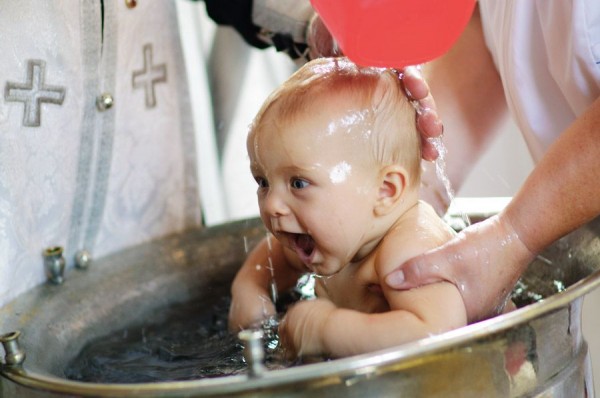
infant_baptism-600x398

To the tune of “London Bridge Is Falling Down”

The oil goes on Sophie’s head, Sophie’s head, Sophie’s head,

The oil goes on Sophie’s head, for a blessing.

The water goes on Sophie’s head, Sophie’s head, Sophie’s head,

The water goes on Sophie’s head, now she’s christened!

The candle goes to Sophie’s home, Sophie’s home, Sophie’s home,

The candle goes to Sophie’s home, God is with her!


(Some fudging of the rhythm may be needed, depending on the child’s name – you can always just use “the baby” or “the child” instead of the name.)


To the tune of “Baa Baa, Black Sheep”

This can go right after the baptism itself

Welcome, welcome, to our family!

God has chosen you and me.

Washed in the water, together on the way,

We welcome the little one who’s joined us today.


To the tune of “Wind the Bobbin Up”

This can be used at the blessing over the water. A gesture can be given for “thank you,” so children can participate in actions throughout the song.

Pour the water in, pour the water in, splash! Splash! Clap clap clap!

Pour the water in, pour the water in, splash! Splash! Clap clap clap!

Thank you to Jesus, God up above!

Thank you for water, thank you for love!

We have come together, now we pray,

God, make this water special today!

Prayer bracelets update

I’ve now done the prayer bracelet activity with the children in my Sunday School group – I used a set of coloured beads from Hobbycraft, and bought some of their cross-shaped beads as well.

We did Psalm 23 for the story part of the session, using this book. The illustrations provided rich material for discussing the psalm, and the children are doing the Old Testament stories of the time of the Kings, so they had some context for when and why the psalm was written.

I then let them loose to make the bracelets, having suggested:

  1. They can assign meaning to the colours themselves (maybe “thank you,” “help,” “wow”) and then hold a particular bead when they feel the need for that prayer.
  2. They could choose a colour for each line of Psalm 23, and then say the psalm as they work their way around the bracelet.
  3. They could rotate between two or three different prayers, like doing a rosary.

I then gave them and their parents the handout (below), to help them learn some of the suggested prayers at home.

Children who wanted to make more than one bracelet were encouraged to make one for a family member or friend.

As our Year 6s were coming up to exams when we did this activity, I suggested wearing the prayer bracelet to their exams and using it if needed to relax them and remind them God was with them.

Prayer bracelets

Starburst conference handouts and slides

This Saturday, I had the privilege of attending the Starburst conference in the Diocese of Peterborough, and leading workshops on All-Age Worship and Storytelling.

Below are the slides from the workshops, and all the handouts, in case you missed out. (The Worship Clock and the Elements of Worship sheet are missing – I don’t have access to them today, so I’ll post them tomorrow.)

For more on the Beulah Land “fuzzy felt” Bible storytelling, you can visit Mustard Seed Kids (be aware this is my company, so there’s a conflict of interest).

For more on Godly Play, visit Gody Play UK’s website.

Starburst All-Age Worship (presentation slides)

Starburst Storytelling (presentation slides)

Basic Resource List Starburst

Going to Church No Diocesan Branding

Going to Church Older No Diocesan Branding

Helping Kids With Behaviour In Church

Whispering in Church

The Big Story – concepts

Pray and Play Corners_full versionPray and Play Corners_full version2Pray and Play Corners_full version3Pray and Play Corners_full version4

Tools, not toys

childrenThis is a wonderful article on how to use the new craze for “spinners” productively, to help children focus, accept differences, and “fidget productively.”

It’s very applicable to churches – worship, including in Junior Church, often requires periods of sitting still, listening, and so on, which some children find difficult. Providing ways for children to fidget productively – with pew bags or liturgy boxes or physical prayer objects or just good old-fashioned paper and pens – can help children engage more deeply in worship and feel more at home in church.

(Link will open in a new tab.)