Harvest Skit

Those of you responsible for sorting out All-Age Harvest services may have felt your heart sink when you saw this year’s readings – bits from Deuteronomy and 2 Corinthians that have little to no context, and no narrative, and some similarly difficult bits from the Gospels – teachings and sayings rather than stories.
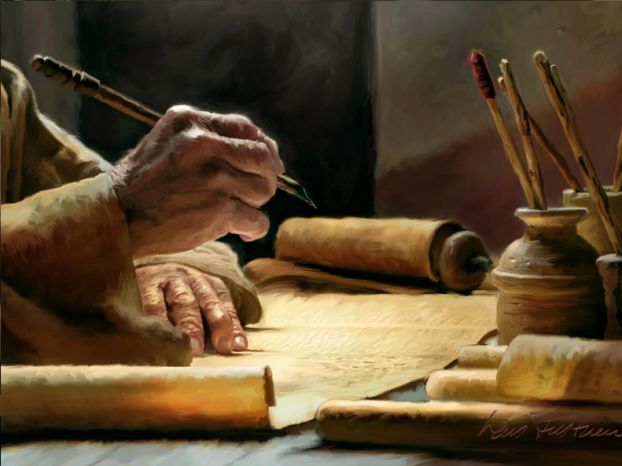
paul

I’ve written a short skit to put the Epistle reading into some context and provide a visual focus. You probably wouldn’t need more than 10 minutes’ rehearsal to make everyone feel confident doing this, and the three participants could be all different ages.

You’ll need a table and a chair, and a piece of paper to be the letter.

WRITING A DIFFICULT LETTER

A skit for Harvest Festival, Year A, based on 2 Corinthians 9:6-15

PAUL is sitting at a desk.

Narrator: Today we join Paul, about 20 years after Jesus has died and risen again. Paul is writing a letter to one of the many churches he has helped to start.

(enter Titus)

Titus: Hello, Paul.

Paul: Ah, Titus – just the person I wanted to see.

Titus: I’m off to Corinth soon – you said you had a letter for the church there that you wanted me to bring?

Paul: Yes. They’ve promised a large gift to help the poorer churches, and all the saints there, and I need you to collect it. I’ve told them you’re coming, and that you hope to collect this gift.

Titus: That’s a difficult letter to get right.

Paul: Yes, nobody likes to be asked for money. They have promised, but I want to make sure they think of it as a gift and not as money I’m demanding from them.

Titus: Why does that matter? As long as the people who need the money get it, isn’t that the point?

Paul: It’s about relationships, though. Sharing what we have with one another is one way of showing our love. God cares about that, and he also cares about what’s in our hearts as well as our actions.

Titus: That’s true. Have you prayed about what to say?

Paul: I have. Can I read this, and ask what you think? Remember, the people in Corinth are very wealthy – they could give a lot, if they wanted – so I’m writing especially for them.

(Paul picks up the letter)

Narrator: A reading from the second letter of Paul to the Corinthians, Chapter 9.

Paul: The point is this: the one who sows sparingly will also reap sparingly, and the one who sows bountifully will also reap bountifully. Each of you must give as you have made up your mind, not reluctantly or under orders, for God loves a cheerful giver. And God is able to provide you with every blessing in abundance, so that by always having enough of everything, you may share abundantly in every good work. As it is written,

“He scatters abroad, he gives to the poor;

his righteousness endures forever.”

God, who supplies seed to the sower and bread for food will supply and multiply your seed for sowing and increase the harvest of your righteousness.

You will be enriched in every way for your great generosity, which will produce thanksgiving to God through us; for the giving of this ministry not only supplies the needs of the saints but also overflows with many thanksgivings to God. Through the testing of this ministry you glorify God by your obedience to the confession of the gospel of Christ and by the generosity of your sharing with them and with all others, while they long for you and pray for you because of the surpassing grace of God that he has given you. Thanks be to God for his indescribable gift!

Narrator: For the wisdom that guides us …

All: We praise you, O Lord.


For some more Harvest resources, check out Flame Creative Kids.
Starburst conference handouts and slides

This Saturday, I had the privilege of attending the Starburst conference in the Diocese of Peterborough, and leading workshops on All-Age Worship and Storytelling.

Below are the slides from the workshops, and all the handouts, in case you missed out. (The Worship Clock and the Elements of Worship sheet are missing – I don’t have access to them today, so I’ll post them tomorrow.)

For more on the Beulah Land “fuzzy felt” Bible storytelling, you can visit Mustard Seed Kids (be aware this is my company, so there’s a conflict of interest).

For more on Godly Play, visit Gody Play UK’s website.

Starburst All-Age Worship (presentation slides)

Starburst Storytelling (presentation slides)

Basic Resource List Starburst

Going to Church No Diocesan Branding

Going to Church Older No Diocesan Branding

Helping Kids With Behaviour In Church

Whispering in Church

The Big Story – concepts

Pray and Play Corners_full versionPray and Play Corners_full version2Pray and Play Corners_full version3Pray and Play Corners_full version4

Tools, not toys

childrenThis is a wonderful article on how to use the new craze for “spinners” productively, to help children focus, accept differences, and “fidget productively.”

It’s very applicable to churches – worship, including in Junior Church, often requires periods of sitting still, listening, and so on, which some children find difficult. Providing ways for children to fidget productively – with pew bags or liturgy boxes or physical prayer objects or just good old-fashioned paper and pens – can help children engage more deeply in worship and feel more at home in church.

(Link will open in a new tab.)


Simple Prayer Idea

beads

My Sunday School kids often come in with friendship bracelets or beaded jewellery they’ve made, so I’m thinking I can turn that interest into a prayer activity.

I’m planning to separate the beads by colour and assign each colour to a simple one-line prayer. For example:

RED: Please protect everyone I love.

ORANGE: I have so many questions – help me hear your answers.

YELLOW: Shine your light into the dark places.

GREEN: Protect this beautiful earth you’ve made.

BLUE: Be with me when I’m feeling sad and blue.

PURPLE: Forgive me when I realise I’m sorry.

WHITE: Thank you for all the good things.

BLACK: Help everyone in the world who needs you.

You can either print out the sentences, laminate them, and tie them onto the bracelets when they’re done (print on both sides so the card isn’t huge), or you can provide them as separate cards.

Allow children to make their own patterns with the different colours, then allow them to spend some time using the bracelets to pray. There are two ways to use the bracelets (maybe you or your kids can think of more) – and they’re both appropriate at different times:

  1. Hold each bead in turn and say the sentence that goes with it. Pray your way around the whole bracelet.
  2. When you need a particular prayer, use the beads of just that colour to help you connect with that prayer.

Getting Started slides from 15th March

pray-and-play8When I run training sessions, I often refer people to this blog to get the slides I used – these are for the “Getting Started in Children’s Ministry” training held on 15th March 2017 at St Andrew’s in Biggleswade. Click on the link at the bottom to download.

Topics include:

Opportunities for mission and ministry

Creating a culture of welcome

A video clip from Rev on how NOT to manage change

Answers from lots of clergy and children’s workers on “what do you do when people complain about children making noise in the service?”

Baptism/Christenings

A resource list

Children’s corners (Pray and Play areas)

Getting Started


Children’s Spirituality

11338852633_ef41fae0e0_oI’ve had the opportunity a few times recently to talk about children’s spiritual development in a more academic way.
The slides for this talk are attached – both a longer and shorter version.

The longer version includes a clip from the TV show “Outnumbered,” if you’re into that sort of thing – to find out what that has to do with children in church, you’ll just have to read the presentation!


childrens-spirituality-theory

childrens-spirituality-shorter-version

Imaginative Spiritual Play in action

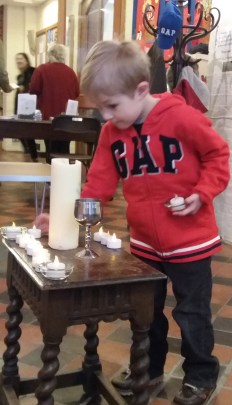
20170205_093750Those of you who have been to any of my workshops or training sessions might have heard me talk about “imaginative spiritual play” and how to facilitate it. Yesterday, Patrick, aged 5, gave me a good example.
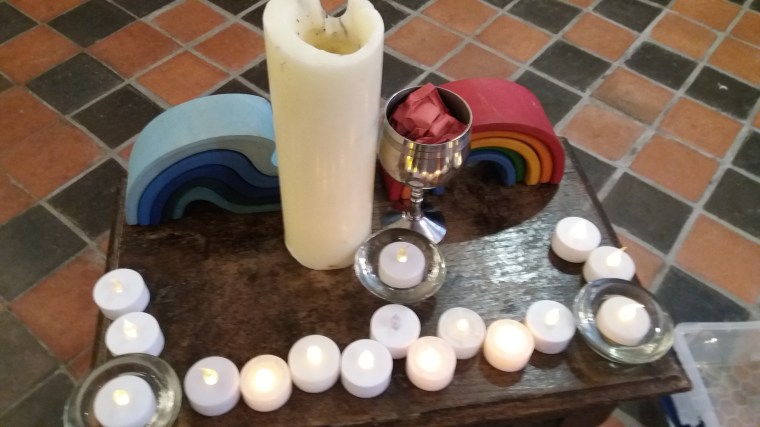
His mum was leading one of the Sunday School groups, so he arrived early. As the space was set up, he started playing – first, he arranged the electric candles on the altar.

What I did: got more candles when he asked, helped him come up with an idea on how to arrange them when he was frustrated that there weren’t enough to go all the way around.

Then he asked me if I had any red paper. He balled up the red paper and stuck it in the chalice to be wine.

20170205_094351

He also went to the toy corner and got the wave and the rainbow toys and set them on the altar.

What I did: Asked him about his setup, using open-ended questions, e.g., “would you like to tell me about what you’ve made?” rather than “is that rainbow from the Noah story?”

When I asked him about his setup, he explained that the water and the rainbow were, in fact, from the Noah story, and asked me if I’d heard this story.

What I did: Instead of saying, “yes, I know that story,” I asked him to tell it to me.

20170205_094928Using the rainbow and the water wave, he briefly recapped the Noah story, and then asked if we could take out the plastic animals from the cupboard to play with them. As the service was about to start, so we had to go into the main worship area, I said no, but reminded him there was a Noah’s Ark toy in the church’s Pray and Play area if he wanted to go and play with that during the start of the service, before Sunday School began.
What made this work:

  1. Easy availability of toys that aren’t proscriptive in their usage – flexibility of symbolism in, for example, the water toy, lets it be used for play based around lots of different stories, or around baptism, or just exploring its shapes and colours and textures and becoming familiar with the image that way. The toy corner in our Sunday School areas, as well as our Pray and Play area, doesn’t change that much – it’s not tied to the story of the day. The same toys are available year round, with a few extra at festivals.
  2. A pretty laissez-faire approach from the facilitator. This episode was child-led. I was the audience – he wanted me to see what he was doing – but not the leader. I helped when asked, but I didn’t direct his play or tell him what meaning to make from it.
  3. Patrick’s familiarity with Bible stories. Patrick’s mum is a Sunday School volunteer and leads our toddler group. She reads Bible stories at home and Patrick is in church most Sundays. But that doesn’t mean she’s doing anything complicated – she’s just making sure he knows the stories, the same way he becomes familiar with, say, Thomas the Tank Engine stories. That’s the foundation of this kind of play, and it isn’t hard to do.


Free Holy Week stuff!

12Tomorrow is our day on Creative Holy Week for All Ages – so for those of you who can’t be there, here are all the resources.

You’ll find:

  1. A script for a walk-through of the whole Passion story. This is great for Messy Church or clubs or other settings where the children probably won’t be in church for Holy Week itself and may not get anything between Palm Sunday and Easter (or not even that). This is in the file labelled “Risen With Christ Resource Pack” and is based on the Prayer Walk in Gretchen Wolff Pritchard’s book Risen With Christ, which you can get here. (It’s worth dealing with the antiquated website and having to order by email or post – it’s a very useful book.)
  2. A summary of how we used the imagery of trees throughout our worship in Lent, Holy Week, and Easter (also in the first file below).
  3. A plan for an all-age Maundy Thursday service. This works for groups up to about 20 – for larger groups, you’ll need to rework it. We have our all-age service at 5:30 and our main Eucharist at 8 – the all-age service tends to attract families and older people who don’t want to be out late, while the Eucharist gets those in between.
  4. The Beulah Land Exodus story script, which is used in the Maundy Thursday service.
  5. The service sheet for my Children’s Stations of the Cross, which provides pretty much everything you need to re-create the service.
  6. Materials which make the transition period of the Great Vigil of Easter much more interactive and dramatic. Many of these are also based on what’s found in Risen With Christ, which in turn was largely inspired by Rick Fabian and Don Schell, who planted the church of St. Gregory of Nyssa in San Francisco (in this setup, the service starts with the kindling of the New Fire and then moves on to the Old Testament readings, instead of vice versa):
    1. The Noble Joseph” – Orthodox Bulgarian chant, used at the end of the Old Testament lessons.
    2. The Litany of the Saints – used for procession to the font before the Exsultet.
    3. The Easter Sermon of St. John Chrysostom – used after the Exsultet, culminating in the first proclamation of the resurrection

Don’t forget to also check out my Lent and Easter Pinterest board – and send me anything you find that you think I should add to it!


risen-with-christ-resource-pack

maundy-thursday-family-service-plan

7_exodus

stations-of-the-cross-service-leaflet

noble-joseph

the-litany-of-the-saints

easter-sermon-of-st-john-chrysostom

Baptism Matters

baptism_mattters_cofe-jpg-576x270_q100_crop

Last Thursday, we had a brilliant day’s training on Baptisms with Sandra Millar, Head of Projects and Development for the Archbishops’ Council.

You can follow the day by looking at the #BaptismMatters tweets, but here, off the top of my head, are the Top Ten Things I Remember:

  1. The public calls it a christening, not a baptism. The word “christening” is searched for on Google 12 times as often as “baptism.” When someone rings the church and asks for a christening, they shouldn’t get the reply, “actually, we call it a baptism.” The first word should be “congratulations!” When a couple calls to ask for a wedding, we don’t say, “actually, it’s a marriage service.” We explain that during the wedding, the couple will be married – same for babies. During a christening, the child will be baptised.
  2. In the service itself, symbols matter much more than words. Candle, the oil on the baby’s forehead, the water – these are what parents remember as meaningful. We don’t need to intellectually understand music to find it moving, and the same is true of liturgy. Understanding can come later.
  3. Parents want us to do the God talk. We shouldn’t be ashamed of it.
  4. Parents want to hear language of a journey – a christening is a step on a journey. They’re thinking about the big questions, and we can walk with them.
  5. Godparents really matter. Over 90% of parents said that a big reason for choosing a christening was so their child would have godparents. How can we support and celebrate the godparent/godchild relationship during preparation, the service itself, and afterwards?
  6. Feeling warmly welcomed and celebrated on the day of the service matters to parents.
  7. Guests matter. These people are the child’s community. They are special to the family. They probably have very little experience of church – how can we include them in the service and make them feel welcomed and valued?
  8. The Church of England Christenings website has information for parents, godparents, and guests, as well as the chance to light a virtual candle (and share on social media that you’ve done so) and a church-facing side for clergy and other church workers.  There’s also a Faith at Home newsletter that parents can sign up for.
  9. There are also lots of resources on the Church Print Hub, including prayer magnets for godparents, prayer bookmarks for guests, and resources for Godparents’ Sunday. Many can be personalised with the contact information and logo of your own church.
  10. Follow-up matters. Many parents want the church to invite them to things. Get contact information and permission from christening families and send them invitations whenever you have something coming up that’s appropriate for young children. Don’t take them off your list unless they ask to be removed!